WhatsMiner M63S Hydro vs. Antminer S21 XP Hyd: Which Hydro ASIC Actually Pays in 2026?
Provider pricing and hardware specifications reflect public sources as of May 2026. Verify all figures before any investment decision.
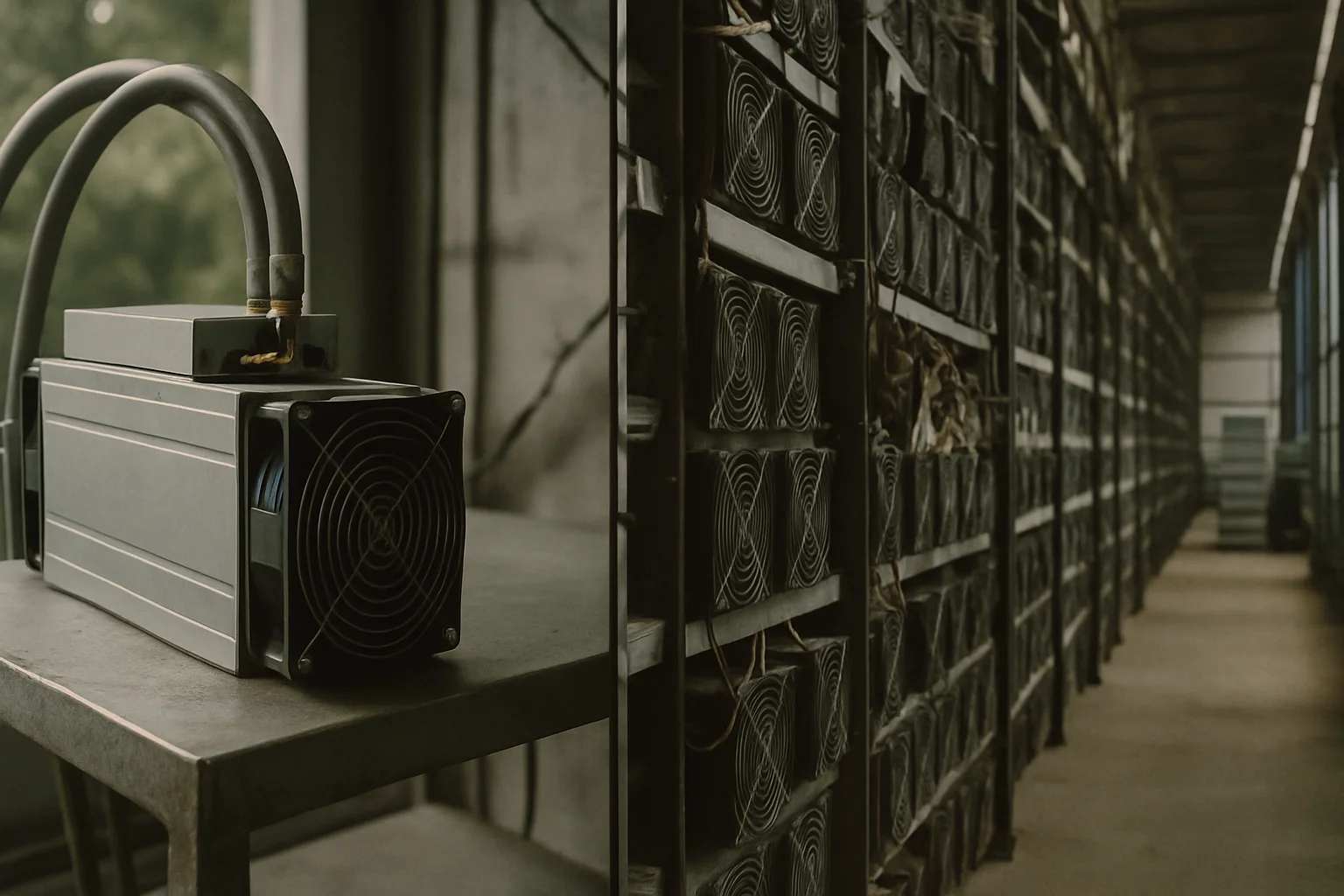
Both machines sit at the top of the current-generation hydro-cooled ASIC market. The WhatsMiner M63S Hydro delivers approximately 390 TH/s at roughly 17–19 J/TH. The Antminer S21 XP Hyd pushes toward 500 TH/s at approximately 15–17 J/TH. On paper, the Bitmain unit wins on efficiency and raw hashrate. In practice, the machine that pays depends almost entirely on where it runs, what the electricity actually costs, and whether the operator can fill the thermal load it generates.
---
Why Hydro Cooling Changes the Equation
Air-cooled ASICs have a ceiling. At a certain power density, fans cannot remove heat fast enough without throttling performance or burning out components. Hydro-cooled (water-cooled) miners push coolant directly through cold plates on the chip stack, enabling higher sustained clock speeds, lower ambient temperature requirements, and meaningfully higher hashrate per unit footprint.
That density advantage matters enormously at scale. A 6 MW facility fitted with hydro miners can pack roughly twice the hashing capacity into the same rack space compared to air-cooled equivalents. For a site like GM3 in Villarrica, Paraguay, where physical footprint and cooling infrastructure are fixed capital, hashrate-per-square-meter is a real operational number, not a spec sheet abstraction.
The tradeoff: hydro miners require closed-loop water-cooling infrastructure, which raises facility CAPEX and demands trained maintenance personnel. They are industrial equipment. Running one in a garage or small colocation rack is not viable. This is precisely why comparing these two machines in isolation from their operating environment produces misleading conclusions.
---
Hardware Specifications: What the Datasheets Say
| Specification | WhatsMiner M63S Hydro | Antminer S21 XP Hyd |
|---|---|---|
| Hashrate | ~390 TH/s | ~500 TH/s |
| Efficiency | ~17–19 J/TH | ~15–17 J/TH |
| Cooling method | Hydro (water-cooled) | Hydro (water-cooled) |
| Power draw | ~7,500 W | ~7,500–8,500 W |
| Generation | MicroBT M63-series (2024) | Bitmain S21-series (2024/2025) |
| Typical market price (May 2026) | see current distributor | see current distributor |
Note: specific pricing is not included here because ASIC secondary-market prices shift with Bitcoin's price and network difficulty. Check current prices with your distributor and always run a break-even at current network difficulty before committing capital.
"Joule per terahash is the decisive efficiency metric, not TH/s." This is one of the clearest assertions in the Bitcoin mining economics literature, and it holds especially true for hydro miners where power draw and cooling costs are tightly linked.
The S21 XP Hyd's efficiency advantage of roughly 2 J/TH over the M63S Hydro translates into meaningful real-world cost differences at scale. On a 1 MW installation running 125 units of either machine, a 2 J/TH gap equals approximately 175,000 kWh of annual electricity consumption. At $0.057/kWh, that is roughly $10,000 per year per megawatt. At $0.10/kWh, it is over $17,500 per MW per year.
---
The Number That Actually Decides the Race
Efficiency specs become irrelevant if you are paying retail electricity rates. As documented in the mining economics framework behind GM3's operations: a 1.8 cent/kWh electricity price difference equals approximately $1 million USD annual result difference on a 6 MW farm.
That figure reframes the entire hardware debate. Whether the S21 XP Hyd beats the M63S Hydro by 2 J/TH matters far less than whether your operator is paying $0.05/kWh or $0.08/kWh.
Consider the arithmetic on a per-unit basis at different electricity rates:
At $0.057/kWh (GM3's current effective rate from Itaipú hydropower):
- A machine drawing 7,500 W continuously for one year consumes approximately 65,700 kWh.
- Electricity cost per unit per year: approximately $3,745.
- Annual BTC produced per unit (at current network difficulty): see quarterly report for live figures, as difficulty changes continuously.
At $0.10/kWh (a common mid-tier hosted rate in DACH or North America):
- Same machine: approximately $6,570 in electricity per year.
- The additional $2,825 per machine per year must come directly from BTC production, reducing net yield.
At the scale of a 6 MW facility, this electricity rate differential represents over $2 million USD annually. The hardware choice contributes perhaps $100,000–200,000 in annual efficiency gains. The energy contract contributes ten times more.
"The machine is the tool. The electricity is the business model." This is the correct frame for any hydro ASIC comparison.
---
Uptime: The Hidden Variable No Spec Sheet Shows
Both machines are rated for high uptime in appropriate industrial environments. But "uptime" as advertised by hosting providers and uptime as actually delivered are frequently different numbers.
"A $0.045/kWh hosting rate in DACH, EU, or North American grids almost always corresponds to a curtailment-enabled contract, with real uptime of 50% to 80%, not a continuous production profile." This is critical when evaluating any hosting offer that combines a low headline electricity rate with a high uptime guarantee. The two claims are frequently incompatible in grid-connected markets.
GM3 in Paraguay achieves approximately 96% real uptime at $0.028–0.057/kWh because Itaipú is a baseload hydroelectric direct-connection, not a curtailment-based grid product. That matters when comparing total BTC produced per machine per year, which is the only metric that actually determines profitability.
Always normalize $/kWh to effective kWh delivered at actual uptime. A $0.045/kWh contract at 60% uptime delivers an effective rate of $0.075/kWh per unit of actual production. A $0.057/kWh contract at 96% uptime delivers $0.059/kWh per unit of actual production. The cheaper headline rate costs more in reality.
---
Where Each Machine Fits Best
WhatsMiner M63S Hydro: The Case For
The M63S Hydro is a mature, proven platform. MicroBT's manufacturing quality and firmware stability have been well-regarded in the industrial mining community since the M50-series. At approximately 17–19 J/TH, it is not the most efficient unit on the market, but the efficiency gap relative to the S21 XP Hyd is modest.
If secondary-market pricing makes the M63S Hydro available at a meaningful discount to the S21 XP Hyd, and if the facility's electricity rate is low enough (below 5 cents/kWh), the return on invested CAPEX can be competitive over a 24–36 month depreciation window.
The machine makes sense for operators running purpose-built hydro-cooling infrastructure who can source units at attractive secondary-market pricing. ASIC prices on secondary markets follow Bitcoin price with a leverage effect. In a flat-to-declining BTC environment, second-generation machines become available at significant discounts.
Antminer S21 XP Hyd: The Case For
The S21 XP Hyd holds the efficiency edge in the current generation. At approximately 15–17 J/TH, it approaches the frontier of what is economically producible at scale before the S23-series fully saturates the market.
For operators with access to sub-5 cent/kWh electricity and a 48-month horizon, the efficiency premium compounds. Every fraction of a J/TH saved across thousands of machines accumulates to real EBITDA. The unit's higher hashrate per machine also reduces the number of units required to hit a target megawatt capacity, lowering maintenance overhead on a per-TH basis.
The case against: the S21 XP Hyd commands a significant new-unit premium. At current prices, the payback differential versus a well-priced M63S Hydro may not justify the CAPEX increase, particularly if the operator is working with short capital cycles or faces liquidity constraints.
---
The Generation-N-1 Principle: Why Green Mining Runs S19-Series
This comparison would be incomplete without a honest disclosure of what we actually run and why.
GM3 currently operates Bitmain S19j XP Hydro as its primary fleet, alongside S19 Pro units. The S19-series runs at approximately 21–25 J/TH, which is less efficient than either the M63S Hydro or the S21 XP Hyd discussed in this article.
This is a deliberate strategy, not a gap.
An Antminer S23 XP (the 2026 flagship) carries a new-unit price of approximately $8,000–10,000. An S19j XP Hyd is available on the secondary market at approximately $1,200–1,800. The efficiency difference between them is roughly 8–10 J/TH.
At $0.028–0.057/kWh from Itaipú, that 8–10 J/TH gap costs far less in annual electricity than the capital cost difference between buying the latest generation and buying the previous one at a fraction of the price. Over a full 4-year halving cycle, the economics favour well-priced N-1 or N-2 generation hardware at very low electricity rates, over expensive top-generation hardware at the same or higher rates.
At electricity rates above 7–8 cents/kWh, this logic reverses. Efficiency becomes existential when energy is expensive. That is exactly the inflection point that determines which operators survive a halving cycle and which do not.
"Wer Mining betreibt, ohne einen direkten, langfristigen Energievertrag zu halten, spielt auf Kredit." When the energy contract is solid, hardware generation selection becomes a capital-allocation question, not a survival question.
---
Break-Even Analysis: Both Machines at GM3's Energy Rates
Using GM3's audited 2025 production cost as a reference framework (approximately $60,000 per BTC at $0.057/kWh, 96% uptime, S19-series fleet), we can model the directional impact of upgrading to more efficient hardware at the same energy rate:
- Moving from ~23 J/TH (S19-series average) to ~17 J/TH (M63S Hydro range) at identical energy rates reduces electricity consumption per TH by approximately 26%.
- Moving to ~16 J/TH (S21 XP Hyd range) reduces it by approximately 30%.
- At 5.7 cents/kWh, a 30% efficiency improvement translates to approximately $570 in reduced annual electricity cost per unit drawing 7,500 W continuously.
Across a 1,500-unit fleet, that is approximately $855,000 in annual electricity savings from fleet modernization to S21 XP Hyd spec, all else equal.
Whether that saving justifies the CAPEX of replacing the fleet is a capital allocation question specific to Bitcoin price, network difficulty trajectory, and available capital. GM3's current modelled cash break-even sits at approximately $54,000 USD per BTC, dropping to approximately $39,000 with 30% heat reuse monetization. Both numbers leave meaningful margin at current Bitcoin price levels.
---
Hydro vs. Immersion: A Note on Cooling Technology
Buyers comparing the M63S Hydro and S21 XP Hyd sometimes ask whether immersion cooling would be a better long-term choice than either hydro-cooled unit.
Immersion cooling submerges miners in dielectric fluid, enabling even higher density than hydro-cooled units and eliminating fan components entirely. The downside: immersion tanks are expensive to install and maintain, fluid replacement and contamination management add operational complexity, and retrofitting existing air-cooled facilities is a major capital project.
For most industrial-scale greenfield sites (2 MW and above), hydro cooling represents the current sweet spot between density, maintainability, and CAPEX. The S21 XP Hyd and M63S Hydro are both purpose-built for exactly this environment.
Immersion remains compelling for ultra-dense deployments above 10 MW where facility footprint is the binding constraint. Below that threshold, hydro cooling is generally preferred by operators with hands-on maintenance teams.
---
What the Comparison Misses If You Stop Here
Both machines produce Bitcoin. Neither machine produces profitable Bitcoin without three things that are not on the spec sheet:
1. A long-term, direct energy contract below 6 cents/kWh. Above that threshold, the halving cycle will eventually put you underwater, regardless of which machine you run. 2. Real uptime above 90%. Headline kWh rates mean nothing if the machine only runs 60% of the time. Normalize for actual delivered uptime before comparing providers. 3. A legal and operational structure that survives operator failure. Hosted-mining customers who own machines inside a third-party data center face the risk that their miner is physically inside another company's insolvency proceeding. Investors in a Swiss AG with a published Handelsregister entry (CHE-200.150.787) hold a different class of protection.
Hardware is a capital expenditure. It depreciates from the day it powers on. Economic hardware lifespan is 24–48 months. The energy contract and the legal structure outlast any specific machine.
"Struktur schlägt Spekulation." That is not a slogan. It is the actual lesson of the hardware comparison you just read.
---
Frequently Asked Questions
Is the WhatsMiner M63S Hydro or the Antminer S21 XP Hyd more efficient in 2026? The Antminer S21 XP Hyd holds the efficiency edge at approximately 15–17 J/TH versus the M63S Hydro's approximately 17–19 J/TH. In absolute terms the difference is meaningful at scale, but it is secondary to the electricity rate your facility actually pays. At sub-5 cent/kWh electricity, both machines are highly profitable. At rates above 8 cents/kWh, neither machine survives a post-halving compression reliably.
Can I run a hydro-cooled ASIC in a small colocation facility? No. Hydro-cooled miners require closed-loop water-cooling infrastructure, chillers or heat exchangers, and trained maintenance personnel. They are designed for industrial deployments at 1 MW scale and above. Attempting to run them in standard air-cooled colocation environments will void warranties and likely damage the hardware.
Why does Green Mining run S19-series hardware instead of the newer S21 XP Hyd or M63S Hydro? At electricity costs of $0.028–0.057/kWh (GM3's rate from Itaipú hydropower), the efficiency premium of newer generation hardware does not justify the capital cost differential. An S19j XP Hyd is available on the secondary market at roughly $1,200–1,800 versus $8,000–10,000 for a new S23 XP. The efficiency gap between generations costs far less in electricity at our energy rate than the CAPEX gap. This calculation reverses above approximately 7–8 cents/kWh, where efficiency becomes existential.
What does "96% uptime" actually mean in practice, and how does it compare to hosting providers? 96% real uptime means the fleet produces BTC approximately 8,410 hours per year out of 8,760 total hours. GM3 achieves this because Itaipú is a baseload hydroelectric source with a direct ANDE supply contract, not a curtailment-based grid product. Many hosted-mining providers advertise 99% uptime at their lowest price tier, which in DACH, EU, and North American grids typically implies curtailment contracts with effective uptime of 50–80%. Always ask your hosting provider for audited real uptime figures, not contractual SLA numbers.
How does the halving affect S21 XP Hyd and M63S Hydro profitability? The April 2024 halving reduced the block reward to 3.125 BTC. At constant Bitcoin prices and rising network hashrate, both machines produce fewer BTC per unit of electricity consumed than before the halving. Operators with energy costs above 7–8 cents/kWh are structurally disadvantaged in this environment. Operators with direct hydropower contracts below 6 cents/kWh retain positive margins across realistic Bitcoin price scenarios. The machines matter; the energy contract matters more.
Is investing in a hydro-mining ASIC the same as investing in Green Mining? No. Buying an ASIC and placing it in a hosted-mining facility makes you a service-contract counterparty. You own the hardware, which depreciates over 24–48 months, and you carry single-machine risk, operator-failure risk, and hardware-obsolescence risk directly. Investing in Green Mining means becoming a shareholder in GM3 Technologies AG, a Swiss company registered in Zug, operating a hydro-cooled fleet in Paraguay. You own equity in the operation, receive quarterly BTC distributions directly to your wallet, and hold AGM voting rights. For details on the regulated investment instrument (BaFin-WIB gestattet 27.5.2025, letzte Aktualisierung 12.3.2026), visit greenmining.io.
---
Past performance is not an indicator of future results. Investments in Bitcoin mining carry risks, including the possible total loss of invested capital. This article is for informational purposes only and does not constitute investment advice. Consult a qualified financial and tax advisor before making any investment decision.