WhatsMiner M66S Immersion Profitability & Hosting Guide 2026
The WhatsMiner M66S Immersion is a strong miner on paper. Whether it is profitable in 2026 depends on one variable above all others: your electricity cost. At $0.05/kWh it produces a margin. At $0.10/kWh it does not. This guide breaks down the hardware, the cooling economics, and what a Paraguay-grade hosting rate actually changes.
> Provider pricing reflects public sources as of May 2026; verify before any investment decision.
---
What Is the WhatsMiner M66S Immersion?
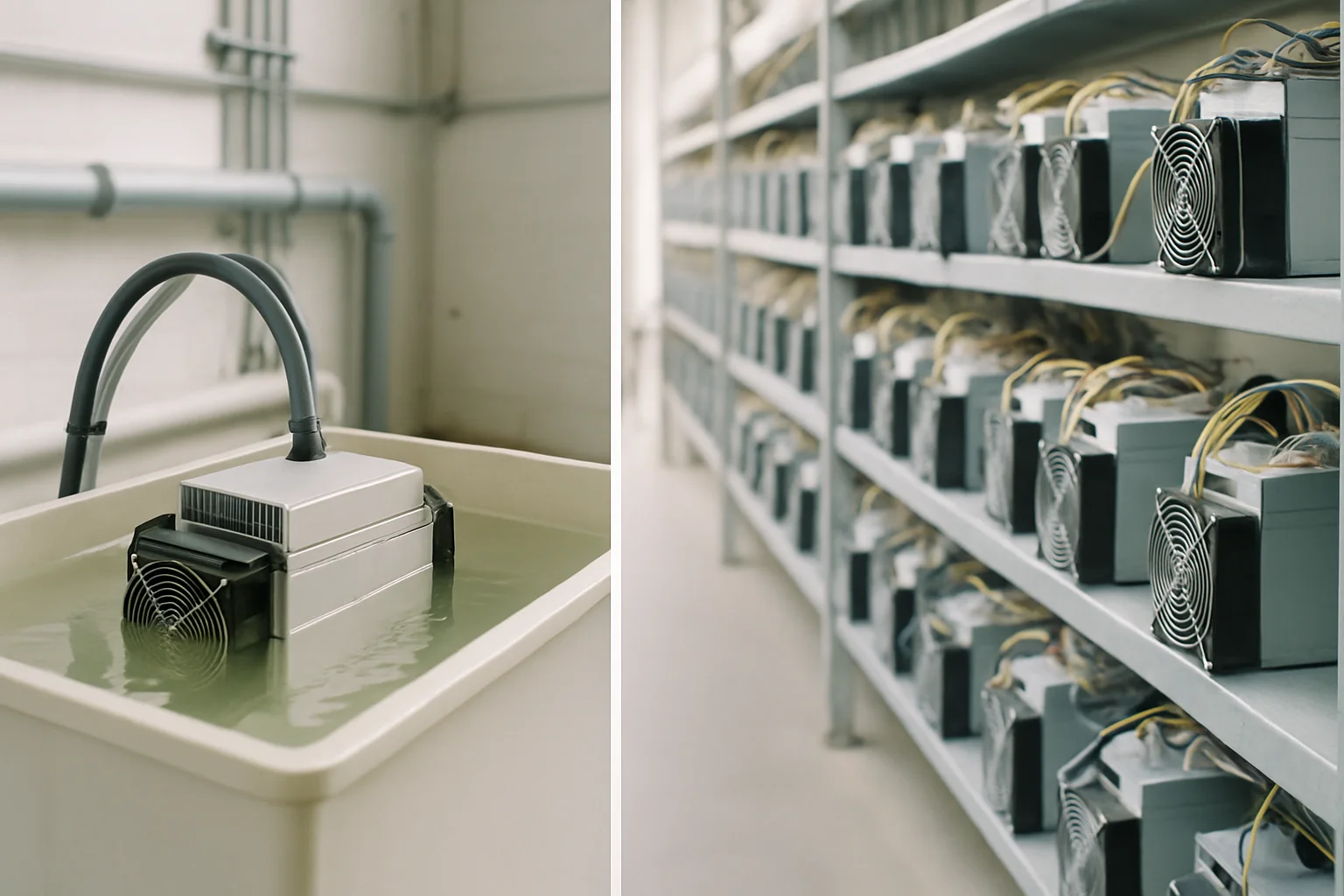
MicroBT's WhatsMiner M66S is the immersion-cooled variant of the M66 series, released across 2024 and 2025. Immersion means the ASIC board is submerged in dielectric fluid rather than cooled by air fans.
The result is higher thermal density, lower noise, and the ability to push hashrate closer to the chip's physical ceiling without throttling.
In the M66 lineup, the M66S sits above the standard M66 in sustained hashrate. Its efficiency is rated at approximately 16-18 J/TH, according to MicroBT's published specifications. That places it in the same efficiency tier as Bitmain's S21-series air-cooled units, but with the thermal headroom that immersion provides.
The 298T variant (often searched as "whatsminer m66s 298th") refers to the 298 TH/s nominal hashrate SKU.
---
Immersion vs. Air Cooling: The Real Economics
Why cooling method changes your cost structure
Air-cooled miners require significant airflow infrastructure: raised floors or outdoor containers, industrial fans, inlet/exhaust separation, and filter maintenance. In hot climates above 35°C, air cooling alone often requires chiller assistance, adding capital expenditure and ongoing power draw.
Immersion eliminates fan power entirely. Typical fan overhead on an air-cooled ASIC runs 3-8% of total power draw. On a fleet of 500 machines at 3.5 kW each, that is roughly 52-140 kW of wasted electricity doing nothing but moving air.
The immersion fluid itself (typically a single-phase dielectric or a two-phase fluorocarbon) requires a pumping system and a dry cooler or cooling tower. Capital outlay is higher up front. Operating costs per kWh consumed by the miner, however, drop.
Hashrate stability is the underreported advantage
An air-cooled miner in a warm environment regularly throttles hashrate when chip temperature exceeds its threshold. The rated 298 TH/s becomes 270-280 TH/s in practice during peak ambient periods.
Immersion-cooled chips run at stable temperature year-round. The 298 TH/s you pay for is closer to the 298 TH/s you receive. Over a 12-month period, that difference compounds. A 5% hashrate gap on a 298 TH/s machine means roughly 15 TH/s of foregone contribution to every block solved.
> "The dominant ongoing cost factor is electricity. And whoever has the cheapest electricity wins the competition. It is that simple." (Green Mining, Härter als Gold)
---
WhatsMiner M66S Profitability: The Numbers in 2026
The variables that matter
Bitcoin mining profitability in 2026 runs through four inputs:
1. Hashrate (TH/s produced) 2. Power consumption (kW) 3. Electricity cost ($/kWh) 4. Network difficulty and BTC price
The Cambridge Centre for Alternative Finance (CBECI) tracks global hashrate, which passed 800 EH/s in early 2026, making difficulty the highest in Bitcoin's history. After the April 2024 halving, the block subsidy dropped to 3.125 BTC per block (down from 6.25 BTC). Revenue per terahash is structurally lower than it was in 2023.
This means efficiency is no longer optional. It is the selection mechanism.
Electricity cost sensitivity
At a typical retail hosting rate in Europe or North America of $0.08-0.12/kWh, the M66S Immersion runs at or below breakeven at current difficulty. The hardware costs are not the issue. Running costs are.
At $0.057/kWh (the upper bound of the Itaipú-sourced electricity rate at GM Data Centers AG's Paraguay site), the margin picture changes. At $0.028/kWh (the lower bound of the same contract), the M66S becomes structurably profitable across most BTC price scenarios above $50,000.
GM Data Centers AG's flagship site in Villarrica, Paraguay operates on direct hydropower contracts sourced from Itaipú overflow, at $0.028-$0.057/kWh. That rate is not a promotional figure. It is an industrial direct contract, not a curtailment-based deal.
> Industry caution: some hosted-mining providers advertise low $/kWh rates alongside 99% uptime claims simultaneously. In DACH and North American grids, a genuinely low rate typically implies a curtailment contract, meaning the host can cut your power during peak grid demand. Real uptime may be 50-80% of nameplate. Always normalize advertised $/kWh to actual delivered uptime before comparing.
GM3's 2025 uptime was ~96%, on baseload hydro contracts with no curtailment clause. That is the correct comparison basis.
Production cost benchmark
GM Data Centers AG's current production cost stands at $56,351 per BTC (as of June 2026). The global average mining cost per BTC is estimated at approximately $84,000 by CoinMetrics and comparable research sources. That is a ~33% structural cost advantage before any hardware-efficiency argument.
This cost level is produced by the M66S and S19-series fleet at Paraguay electricity rates. The M66S Immersion, rated at 16-18 J/TH, competes directly with the fleet's existing S19j XP Hydro units (21-25 J/TH) on efficiency. An M66S-dominant fleet would push production costs lower, all else equal.
---
Immersion Infrastructure: What a Hosting Setup Actually Requires
Capital expenditure
Immersion tanks (typically 100-200L per machine) plus a dielectric fluid fill, pumping circuit, and dry cooler represent meaningful upfront capital. A 500-machine immersion build runs materially higher in infrastructure cost than the equivalent air-cooled container build.
For a single machine owner looking at hosted immersion: the facility operator absorbs this capital cost. What you pay is the monthly hosting rate, which reflects that capital recovery.
The "hydro" vs. "immersion" distinction for the M66S
The "M66S" suffix in MicroBT's naming does not automatically mean immersion. MicroBT uses "Hyd" as the suffix for their hydro-cooled (two-phase immersion or direct liquid cooling) variants across multiple series, including the M63 Hyd and M66S Hyd. The standard M66S uses air cooling.
When evaluating a hosting contract or a used hardware purchase, confirm whether you are buying the air-cooled or liquid-cooled variant. Efficiency and hashrate specifications differ.
> Bitmain uses a parallel convention: "Hyd" variants like the S19j XP Hyd are water-cooled and intended for industrial deployments. The same "Hyd" suffix logic applies across both manufacturers.
---
Paraguay vs. DACH Hosting: Side-by-Side Comparison
Below is a factual comparison of key hosting variables. These figures reflect Green Mining's Paraguay site and publicly available DACH/EU retail hosting ranges as of May 2026.
| Variable | Paraguay (GM3) | Typical DACH/EU Retail Hosting |
|---|---|---|
| Electricity cost | $0.028-0.057/kWh | $0.07-0.15/kWh |
| Uptime 2025 | ~96% (baseload hydro) | Varies; curtailment contracts common at lower rates |
| Cooling type | Hydro/immersion compatible | Air-cooled standard; immersion rare |
| Energy source | 100% hydropower (Itaipú) | Mixed grid; renewable share varies |
| Production cost/BTC | ~$56,351 (June 2026) | Varies by contract |
| Legal structure | Swiss AG, FINMA framework | Varies |
---
Why the Ownership Structure Matters More Than the Hardware
A M66S in a cheap facility sounds good. But who owns the infrastructure?
In a standard hosted-mining contract, you buy the hardware, a third party runs it, and your returns depend entirely on that party's operational continuity. If the host goes insolvent, the machines go with the estate. There is no balance sheet protecting you.
GM Data Centers AG structures its sites differently. Investors become shareholders in a Swiss AG (GM3 Technologies AG), registered in the Swiss commercial register. The site, the hardware, and the operational revenue sit on a corporate balance sheet with audited financials. The 2025 net profit for GM3 was CHF 261,639.52, on revenue of CHF 1,441,454.
The 300+ investors across the Green Mining structure (approximately 264 in GM3 alone, as of April 2026) receive quarterly BTC distributions directly to their own wallets. No intermediary holds the Bitcoin.
> "You own the data center. The data center produces your Bitcoin." (Green Mining brand tagline)
In a 2025 investor survey (n=79, October 2025), 67% of investors cited "regular Bitcoin dividends" as their primary reason for investing. 91% ranked transparency and profitability as core values. NPS stood at +48.
---
WhatsMiner M66S Price: What the Market Shows in 2026
Used M66S units (air-cooled) are trading on secondary markets in the $1,800-2,800 range as of mid-2026, depending on condition and hashrate bin. The hydro/immersion variant commands a premium due to lower unit count in circulation and higher infrastructure dependency.
For context: a new Bitmain S23 XP currently runs approximately $8,000-10,000. Green Mining's hardware strategy deliberately targets generation N-1 or N-2 ASICs (currently the S19-series), on the basis that used hardware at $1,200-1,800 per unit, operating on sub-$0.057/kWh electricity, delivers better cycle-adjusted ROI than new-generation hardware at three to five times the price.
The M66S sits at the crossover point: newer than the S19-series but not yet as expensive as the S23. At the right electricity rate, it is a competitive fleet-building choice for 2026.
---
Green Mining's Hosting Approach: What Investors Access
Green Mining does not sell hosting contracts in the retail sense. The model is co-mining equity. You become a shareholder, not a hosting customer. The distinction matters legally and practically.
The 2025 average ROI for GM3 investors was approximately +10% p.a. in BTC terms, with early investors seeing up to +20%. The EBIT margin for the GM3 site in 2025 was approximately 16% on USD 1.77M in revenue.
For investors in Germany, access to the GM3 investment product is handled via the company's partner, Bitalo AG, in compliance with BaFin requirements. Concrete subscription terms, pricing, and offer parameters are available exclusively through that channel.
For Swiss and international investors, details are available directly through greenmining.io.
---
Frequently Asked Questions
Q: Is the WhatsMiner M66S Immersion more profitable than the air-cooled version? A: In a properly configured immersion facility with sub-$0.06/kWh electricity, yes. Immersion delivers more stable hashrate over time and eliminates fan overhead. The gain is not dramatic on a per-machine basis, but across a fleet operating 24/7 for four years, the compounding effect on uptime and efficiency is meaningful.
Q: What electricity rate does the WhatsMiner M66S need to be profitable in 2026? A: At current network difficulty and a BTC price around $100,000, the M66S requires approximately $0.05-0.07/kWh to produce a positive margin after hardware amortization. Below $0.05/kWh, margins are solid. Above $0.08/kWh, profitability becomes very thin or negative.
Q: How does Paraguay compare to European hosting for the M66S? A: Paraguay hydropower contracts at $0.028-0.057/kWh represent some of the lowest industrial electricity rates in any active mining jurisdiction. European retail hosting typically runs $0.07-0.15/kWh. The difference is not incremental. It is the difference between a profitable and an unprofitable operation at current difficulty.
Q: What is the WhatsMiner M66S hashrate specification? A: The M66S is rated at approximately 298 TH/s at nominal conditions. The "298T" or "M66S 298TH" searches refer to this SKU. MicroBT's M66S Hyd (liquid-cooled) variant may differ; always confirm specifications from MicroBT's official site before purchase.
Q: Does Green Mining offer hosting for the WhatsMiner M66S? A: Green Mining does not offer individual machine hosting. The model is equity co-mining via a Swiss AG structure. Investors own shares in the operating company, receive quarterly BTC distributions, and participate in site-level profitability. The hardware fleet is managed collectively.
Q: How does immersion cooling affect long-term hardware lifespan? A: Immersion significantly reduces thermal cycling stress on ASIC components. Air-cooled miners regularly swing between high and low chip temperatures through the day and night cycle. Immersion maintains stable chip temperature, which translates to longer capacitor and board lifespan. Industry operators report 20-30% longer hardware service life in immersion setups, though specific figures vary by site and fluid quality. See current research from Cambridge CBECI for broader mining infrastructure analysis.
---
Past performance is not an indicator of future results. Bitcoin mining involves significant risks, including the possible total loss of capital invested. This article is for informational purposes only and does not constitute investment advice. Consult a qualified financial advisor before making any investment decision.