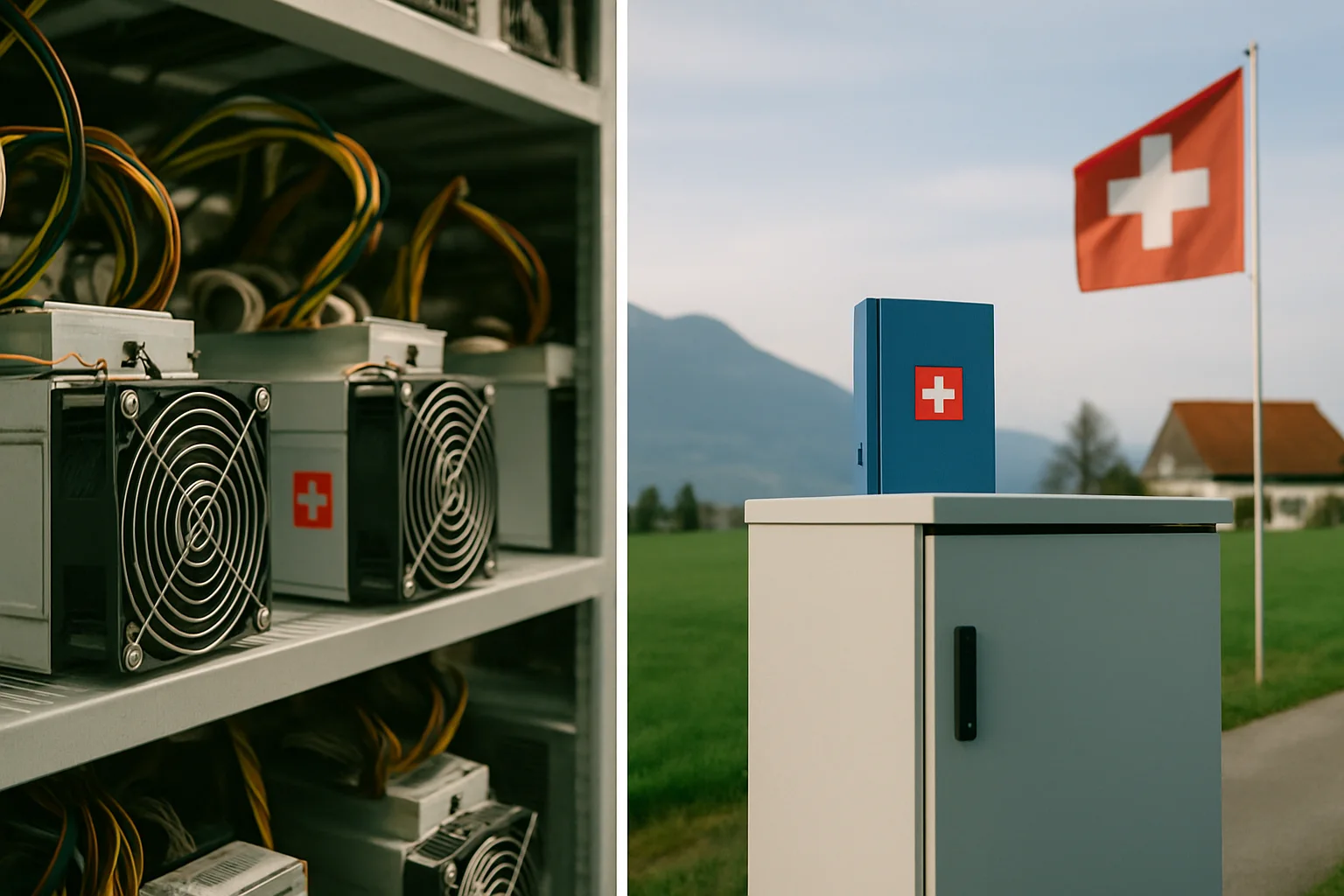
ASIC Hosting Switzerland & DACH: Provider Comparison 2026
If you are searching for ASIC hosting in Switzerland or the broader DACH region in 2026, you have two fundamentally different options in front of you: a service contract with a hosting operator, or equity in a mining infrastructure company. This guide covers what each model actually costs, which providers are active in this market, and why the structural differences matter more than the headline price per kWh.
> Provider pricing reflects public sources as of May 2026; verify before any investment decision.
---
What "ASIC Hosting" Actually Means
Hosted Bitcoin mining has one core structure: you buy or rent an ASIC miner, a hosting operator runs it in their data centre, and you receive the Bitcoin output minus an electricity bill and a management fee.
Three parties, three different interests.
You want maximum uptime and minimum electricity cost. The provider earns on every kWh consumed by your machine, regardless of whether you are profitable. As the ebook "Härter als Gold" frames it: "The provider earns on three things: hardware sale (often marked up), electricity margin, service fee. He earns as long as your machine runs, independent of whether you make a profit or a loss."
That is not a hypothetical conflict. It is the structural design of the model.
---
The Four Active DACH Hosting Providers in 2026
Bitkern (Zug, Switzerland)
Bitkern is the most visible Swiss ASIC hosting brand, founded in 2017 and operating 85,000+ hosted miners across 18+ data centres globally. Their pricing for 2026 runs from $0.045/kWh at the retail LITE tier to $0.075/kWh at the institutional PRO level, with 48-month hosting contracts and a 36-month hardware warranty.
The headline rate of $0.045/kWh looks competitive. The critical question is what uptime corresponds to that rate.
In DACH and European grid environments, hosting contracts priced at the $0.045/kWh tier almost always involve curtailment provisions or off-peak-only operation. Effective real uptime at this tier typically sits between 50% and 80%, not 99%. The 99% uptime figure that Bitkern advertises is achievable only at the upper pricing tier, which lands at $0.075/kWh. Investors comparing providers on $/kWh must normalise for uptime: a 60%-uptime $0.045/kWh contract delivers fewer kWh per machine per year than a 96%-uptime $0.057/kWh contract. The effective rate on a per-produced-kWh basis at the cheaper tier is closer to $0.075/kWh anyway.
Beyond pricing, Bitkern's customers commit to a 48-month contract. ASIC hardware has an economic useful life of 24 to 48 months. You are locking in for the full depreciation cycle of your machine, on terms the provider controls.
MIM (Munich International Mining)
MIM operates from Munich and targets the DACH market with hosted mining, ASIC sales, and consulting. Their pricing is not publicly disclosed; they operate on a request-a-quote model.
That pricing opacity is a friction point for sophisticated investors. It makes side-by-side comparison impossible before the first call, and it suggests the economics are tailored per deal rather than transparently standardised.
MIM's energy procurement scale cannot match industrial direct-contract economics from a dedicated hydropower source. Larger operators negotiate larger ASIC discounts and lower grid tariffs. A Munich-based operation working with German or Central European grid electricity faces structurally higher input costs than a site sitting directly on surplus hydro capacity.
Cryptohall24 (Germany)
Cryptohall24 positions itself on price, with a starter hosting tier from 4.5 ct/kWh (approximately $0.049/kWh at current EUR/USD). Their upper tiers reach roughly $0.085/kWh depending on contract length, hardware generation, and curtailment terms.
The starter tier is aggressive. It is also the tier most likely to carry curtailment provisions or undisclosed fossil-grid sourcing. Cryptohall24 does not publicly disclose its energy mix.
A hosting contract with Cryptohall24 is a service agreement. There is no equity stake in the operator, no shareholder rights, no participation in fleet growth or any future liquidity event.
Miningshop.ch (Switzerland)
Miningshop.ch serves Swiss retail customers with hosted ASIC mining priced from 0.065 CHF/kWh. That rate is roughly double the energy cost of a site running on direct Itaipú hydropower contracts in Paraguay.
Swiss retail electricity rates make mining economics structurally difficult across a full halving cycle. The 2024 halving reduced the block reward to 3.125 BTC. At Swiss grid pricing, the margin between production cost and Bitcoin spot price compresses rapidly in any market drawdown.
---
The Structural Problem With All Four Models
The four providers above share one characteristic: you are a service-contract counterparty, not a shareholder in the operation.
If the operator files for insolvency, your machine is physically inside their facility. Recovering hardware through a foreign insolvency proceeding takes 6 to 24 months and legal fees. By the time you have the machine back, the next generation of ASICs has arrived and your asset has lost 70 to 90% of its secondary-market value, as was documented in the 2022 cycle.
You also bear the full hardware-aging curve alone. Economic ASIC lifespan is 24 to 48 months. A fleet operator amortises hardware obsolescence across hundreds of machines with a defined reinvestment schedule. A single-machine customer absorbs it 100%.
ASIC efficiency has improved from roughly 90 J/TH in 2017 to below 17 J/TH in current flagship models. That is a fivefold improvement in eight years. Each new generation makes the previous one relatively less competitive. When you hold one machine in a 48-month hosting contract, you are holding a depreciating single asset in a market that refreshes every 18 to 24 months.
---
Green Mining: A Different Structure for the Same Underlying Demand
Green Mining (GM Data Centers AG, Handelsregister CHE-200.150.787, Zug, Switzerland) is not a hosting provider in the traditional sense. The product is equity in a Swiss Aktiengesellschaft that owns and operates a Bitcoin mining data centre.
When you invest in Green Mining's GM3 programme, you become a registered shareholder in GM3 Technologies AG, a Swiss AG with its own balance sheet, its own energy contract, and its own quarterly BTC production. You are not buying a machine. You are buying a fractional share of the fleet, the building, the energy contract, and the operating company.
The legal framing matters. Shareholders of a Swiss AG have AGM voting rights, quarterly financial reporting, and Swiss legal jurisdiction for any disputes. A hosting service contract gives you none of those protections.
GM3 Paraguay: The Numbers That Matter
GM3 Technologies AG operates at Villarrica, Paraguay, connected directly to Paraguay's ANDE grid, which draws from Itaipú surplus. Itaipú is the world's second-largest hydroelectric dam. Paraguay consumes roughly 50% of its own generation quota; the surplus flows to industrial buyers at rates that no European grid can match.
Key operational figures for GM3 in 2025:
- Energy cost: $0.028 to $0.057 per kWh (5.7 ct/kWh effective, from Itaipú-backed ANDE contracts)
- Uptime 2025: approximately 96% (baseload hydro connection, not a curtailment-based grid contract)
- BTC produced in 2025: 14.5 BTC
- Revenue 2025: approximately USD 1.77 million (CHF 1,441,454)
- EBITDA 2025: approximately USD 566,000
- EBIT 2025: approximately USD 286,000
- Production cost per BTC (2025): approximately USD 60,000 (approximately CHF 54,000)
- Current production cost (as of June 2026): $56,351 per BTC
- Production margin vs. 2025 BTC spot average: approximately 42%
- Eigenkapitalquote (equity ratio) 2025: approximately 70%
- Active investors in GM3: 264 (as of April 2026)
> Past performance is not an indicator of future results.
The hardware strategy is also deliberate. GM3 runs primarily Bitmain S19j XP Hydro units, with S19 Pro as secondary fleet. The S19 series currently runs at approximately 21 to 25 J/TH. Bitmain's 2026 flagship S23 series achieves approximately 13 J/TH, but at a hardware acquisition cost of roughly $8,000 to $10,000 per unit versus approximately $1,200 to $1,800 for an S19j XP Hydro. At energy costs of $0.028 to $0.057/kWh, the efficiency differential does not justify the capital premium over a full four-year halving cycle. The machine is the tool. The energy contract is the business model.
A 1.8-cent difference in electricity rate translates to approximately one million USD annual result difference on a 6 MW farm. That is the number that makes the Paraguay location a structural advantage, not a marketing claim.
Heat Reuse: A Second Revenue Stream Independent of Bitcoin Price
GM3's mining fleet generates 70 to 80°C exhaust heat across its operating footprint. That heat feeds industrial drying chambers for mango, pineapple, and papaya, under the "Bitcoin Mango" brand. A 6 MW mining farm produces the continuous heating equivalent of 400 German residential homes, 24 hours a day.
The heat reuse programme reduces effective energy costs by 10 to 30%. At 30% heat monetisation, the cash break-even for GM3 moves from approximately $54,000 per BTC to approximately $39,000 per BTC. In a bear market, that difference is existential.
As the ebook states: "It is not an ESG argument. That is mathematics."
---
Side-by-Side: Key Metrics Compared
| Dimension | Green Mining (GM3) | Bitkern | Cryptohall24 | Miningshop.ch |
|---|---|---|---|---|
| Product type | Co-mining (Swiss AG equity) | Hosted ASIC | Hosted ASIC | Hosted ASIC |
| Energy cost | $0.028-0.057/kWh | $0.045-0.075/kWh | ~$0.049-0.085/kWh | 0.065 CHF/kWh |
| Energy source | 100% Itaipú hydropower | Mixed, multi-site | Undisclosed | Swiss grid |
| Real uptime 2025 | ~96% (baseload hydro) | 99% headline (upper tier only) | Not disclosed | Not disclosed |
| Hardware risk | Borne by operator | Borne by customer | Borne by customer | Borne by customer |
| Your legal right | AG shareholder (Wertrecht) | Service contract | Service contract | Service contract |
| Contract term | Equity (ongoing) | 48-month lock-in | Varies | Varies |
| Tradeable | Yes (after 12-month Sperrfrist) | No | No | No |
| Upside on fleet growth | Yes (equity) | No | No | No |
| Regulatory framework | FINMA + BaFin-WIB | None | None | None |
Hosting rates across DACH range from 4.5 ct/kWh at Cryptohall24 (energy mix undisclosed) to 0.065 CHF/kWh at Miningshop.ch. Green Mining's audited cost from Itaipú hydropower is $0.028 to $0.057 per kWh with independently reportable 96% uptime.
---
Who Is Green Mining Right For?
Green Mining is not the right answer for every investor. The decision matrix matters.
Hosted mining may make sense if your capital is below the minimum threshold for an equity structure, if you want hardware CAPEX on your own books for tax reasons, or if your time horizon is 12 to 18 months. Consult your tax advisor before choosing a structure.
Green Mining fits investors who want a 5-year-plus holding period, who want BTC distributions paid directly to their own wallet without operator intermediary, who want Swiss legal jurisdiction, and who want equity participation in fleet growth rather than a service-contract claim on one machine's output.
61% of current GM3 investors report a planned holding period of over five years, according to the GM3 Investor Survey (October 2025, n=79). 94% were Bitcoin holders before they invested. 91% rank transparency and profitability as their core investment criteria.
The structure is not complicated. You own the data centre. The data centre produces your Bitcoin.
Access for German Investors
Access for investors in Germany is handled via our partner Bitalo AG. GM3 Technologies AG holds a BaFin-approved Wertpapier-Informationsblatt (WIB), last updated 12 March 2026. Green Mining is the only DACH-facing Bitcoin mining provider that combines a Swiss AG structure with a BaFin-vetted WIB.
For Swiss and international investors, direct access is available via greenmining.io.
---
Frequently Asked Questions
What is the difference between ASIC hosting and co-mining with Green Mining?
ASIC hosting means you purchase a physical mining machine and pay a third-party operator to run it. Your return depends entirely on that single machine's output minus hosting fees. Co-mining with Green Mining means you become a shareholder in GM3 Technologies AG, a Swiss AG that operates an entire fleet of miners. You receive quarterly BTC distributions proportional to your shareholding, not the output of a single machine.
How does Green Mining's energy cost compare to Swiss hosting providers?
GM3 operates at $0.028 to $0.057 per kWh via direct industrial contracts with Paraguay's ANDE grid, drawing from Itaipú surplus hydropower. Miningshop.ch, the primary Swiss retail hosting provider, prices from 0.065 CHF/kWh, which is roughly double Green Mining's upper energy cost. The gap compounds across a 4-year halving cycle.
What uptime does GM3 actually deliver?
GM3 achieved approximately 96% real uptime in 2025. This is a baseload hydroelectric direct connection, not a curtailment-enabled grid contract. Curtailment contracts, common at the lower-priced tiers of European hosting operators, typically deliver 50 to 80% real uptime. Comparing $/kWh across providers without normalising for actual uptime is the most common analytical error in hosted mining.
What happens to my investment if Green Mining faces difficulties?
As a registered shareholder in GM3 Technologies AG, a Swiss AG registered in Zug, you hold a legally protected equity interest with Swiss legal jurisdiction. GM3 carries an equity ratio of approximately 70% and has been profitable at the site level since Q1 2025. That is not a guarantee of future results, but it is a structurally different risk profile than a hosting service contract, where a provider insolvency leaves you as an international creditor attempting to recover physical hardware from inside a third-party facility.
Is the GM3 Wertrecht tradeable?
Yes. After a 12-month Sperrfrist (lock-up period), Green Mining's Wertrechte are intended to be tradeable. A secondary market is planned for H2 2026. Hosted mining contracts (e.g. Bitkern's 48-month agreements) are not tradeable.
What is the minimum investment to participate in Green Mining?
For specific investment access terms, subscription amounts, and pricing, please visit greenmining.io or contact Bitalo AG for German investor access. Concrete offer terms are not published in this editorial content.
---
Structure Beats Speculation
Mining is not a technology business where the smartest engineers win. It is a location business where the cheapest energy wins.
Swiss grid electricity at 25 to 40 cents per kWh makes home mining unviable. European industrial hosting at 4.5 to 7.5 cents per kWh makes the numbers work during bull markets and compresses during bear markets. Direct hydropower contracts at $0.028 to $0.057 per kWh on a baseload source that runs 96% of the year make the numbers structurally defensible across a full Bitcoin halving cycle.
The machine is the tool. The energy contract is the business model. The legal structure is the protection.
Struktur schlägt Spekulation.
---
Past performance is not an indicator of future results. Investments in Bitcoin mining carry risks, including the possible total loss of capital invested. This content is for informational purposes only and does not constitute investment advice. Consult a qualified financial and tax advisor before making any investment decision.