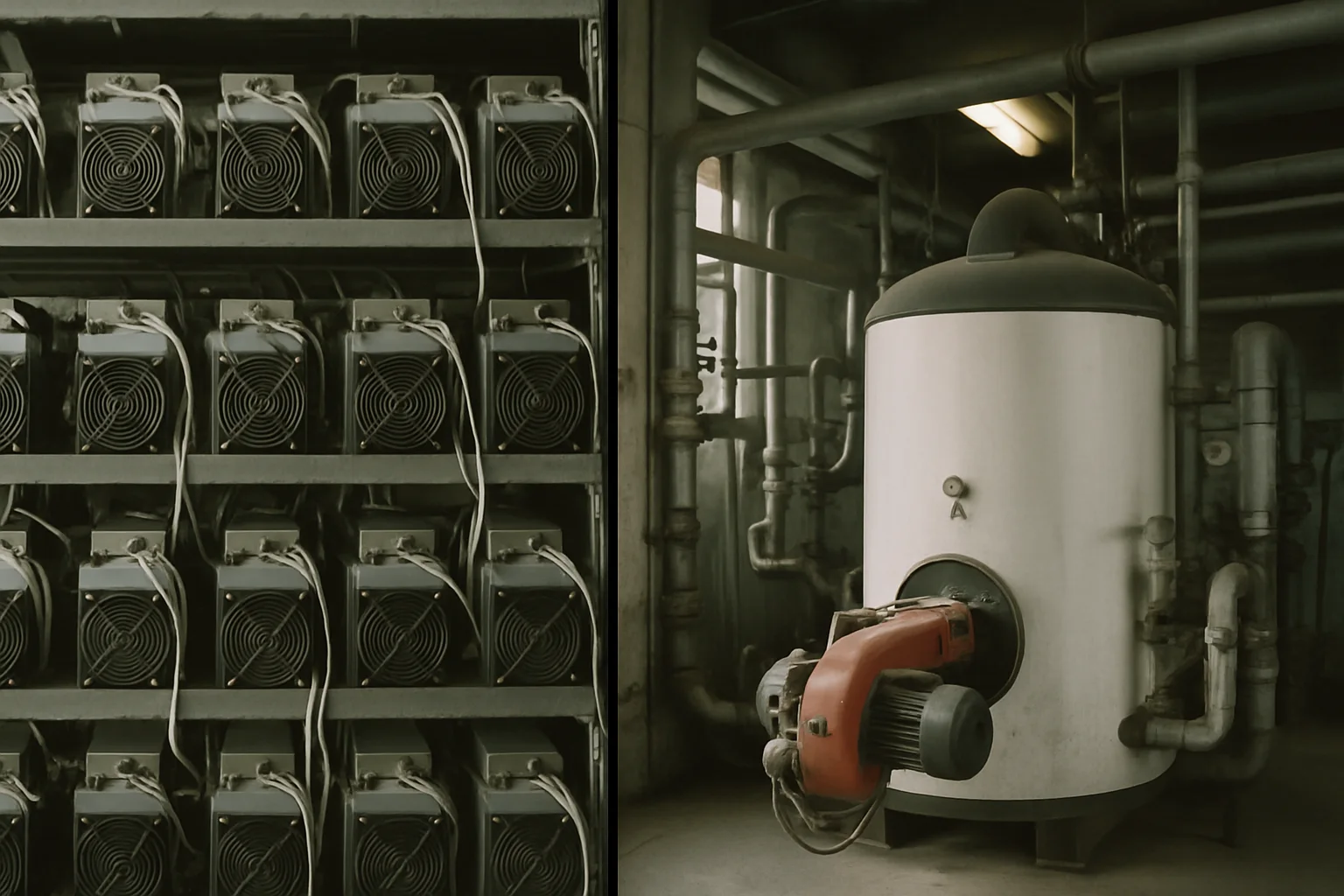
WhatsMiner M63S Hydro 390T: Profitability & Comparison 2026
The WhatsMiner M63S Hydro 390T is one of MicroBT's most capable hydro-cooled ASICs, targeting the same industrial segment as Bitmain's S21 XP Hydro. At roughly 390 TH/s and 17–19 J/TH, it competes directly on efficiency and density. Whether it makes sense in 2026 depends almost entirely on one number: your electricity cost per kWh.
> Provider pricing and hardware market figures reflect public sources as of May 2026. Verify all figures before making any investment or purchasing decision.
---
What Is the WhatsMiner M63S Hydro 390T?
The M63S Hydro is MicroBT's hydro-cooled variant of its M63 series, launched in 2024. It uses liquid cooling to push hashrate density well beyond what air-cooled units can sustain in the same rack footprint.
The "390T" suffix denotes its rated hashrate: 390 terahashes per second. The efficiency range of 17–19 J/TH sits between the older M60/M60S generation (~19–22 J/TH) and the newer M66/M66S (~16–18 J/TH).
That positions it clearly: not the newest generation, but still competitive if purchased at the right price.
Key specifications at a glance
- Hashrate: ~390 TH/s
- Efficiency: ~17–19 J/TH
- Cooling: Hydro (liquid-cooled loop, not immersion)
- Power draw: approximately 6,630–7,410 W depending on firmware mode
- Target environment: Industrial data center with closed-loop coolant infrastructure
This is not a unit you run in a garage or a colocation rack designed for air-cooled hardware. Hydro units require dedicated plumbing, coolant flow rates, and heat-rejection infrastructure. The M63S Hydro is a data-center machine, full stop.
---
M63S Hydro vs. Antminer S21 XP Hydro: Head-to-Head
The honest comparison for any prospective buyer in 2026 is not M63S Hydro vs. M63S air-cooled. It is M63S Hydro vs. Bitmain's S21 XP Hydro, the other major hydro flagship in active deployment.
> "The dominant ongoing cost factor is electricity. Who has the cheapest electricity wins the competition. It is that simple." (Adapted from Green Mining's ebook Härter als Gold)
| Metric | WhatsMiner M63S Hydro | Antminer S21 XP Hydro |
|---|---|---|
| Hashrate | ~390 TH/s | ~473 TH/s |
| Efficiency | ~17–19 J/TH | ~12–13 J/TH |
| Generation | 2024 (M63 series) | 2024/2025 (S21 series) |
| Cooling type | Hydro | Hydro |
| Typical market price (May 2026) | Lower (see note) | Higher (see note) |
The efficiency gap is real. The S21 XP Hydro's ~12–13 J/TH versus the M63S Hydro's ~17–19 J/TH is meaningful at scale. On a 1 MW deployment, a 5 J/TH efficiency advantage translates to roughly 5,000 kWh of savings per day.
At $0.057/kWh (the upper end of GM Data Centers AG's industrial Itaipú electricity cost in Paraguay), that is approximately $285 per day per megawatt, or over $100,000 per year per MW.
But the purchase price spread matters equally. The M63S Hydro trades at a significant discount to the S21 XP Hydro on the secondary market. For operators with very low electricity costs, the cheaper acquisition price can offset the efficiency gap across a full four-year halving cycle.
> "Over a full four-year halving cycle, cheaply purchased previous-generation hardware at low energy costs delivers better ROI than expensive top-generation hardware at higher energy costs." (GM Data Centers AG hardware strategy note, Knowledge Base 2026)
This is precisely the logic behind GM Data Centers AG's current fleet composition: the operation in Villarrica, Paraguay runs Bitmain S19j XP Hydro units, not because they are the newest, but because the economics at $0.028–0.057/kWh make them structurally profitable.
---
Profitability of the M63S Hydro in 2026: The Numbers That Matter
The electricity cost threshold
At current Bitcoin network difficulty and a Bitcoin price in the range tracked by CoinMetrics, the M63S Hydro breaks even operationally at roughly:
- Below $0.05/kWh: generally cash-flow positive at most BTC price scenarios above $50,000
- $0.05–0.07/kWh: marginal; dependent on BTC price remaining above ~$70,000
- Above $0.07/kWh: structurally difficult to sustain profitability across a full cycle
These thresholds are directional. They shift with every difficulty adjustment, which Cambridge CBECI estimates every two weeks based on global hashrate. Any profitability calculator must be re-run after each adjustment.
The halving context
The April 2024 halving reduced the block reward from 6.25 BTC to 3.125 BTC per block. This was the single largest structural cost increase in mining history on a per-BTC basis.
Operators who survived 2024–2025 with healthy margins were those who had locked in low electricity contracts before the event. GM Data Centers AG's GM3 site in Paraguay produced 14.5 BTC in 2025 at a production cost of approximately CHF 54,000 per BTC, against a market average price of approximately USD 103,000 in 2025. That is a production margin of approximately 42%.
The M63S Hydro, running at 17–19 J/TH, requires lower electricity costs than that to match equivalent margins. At $0.028–0.057/kWh (the Itaipú-contract range used by GM3), it would be cash-flow positive. At European or North American grid rates of $0.08–0.12/kWh, the math deteriorates rapidly.
---
Hydro Cooling: Why It Matters for Industrial Mining
Density and uptime
Hydro-cooled units like the M63S Hydro allow significantly higher rack density than air-cooled equivalents. In an industrial-scale facility, switching from air-cooled units to hydro-cooled units can increase effective hashrate by 30–50% within the same building footprint.
GM3's facility in Villarrica runs hydro-cooled Bitmain units and achieved approximately 96% uptime in 2025. That figure is not incidental. Hydro cooling stabilizes chip temperatures, reduces thermal throttling, and extends ASIC lifespan.
The uptime normalization rule
Here is something most hosted-mining and equipment resellers do not disclose: advertised electricity costs must always be normalized against real uptime.
A hosting rate of $0.045/kWh sounds attractive. But if the facility runs curtailment contracts, real uptime may be 50–80%. The economics collapse.
> "A continuous 99% uptime typically requires the upper pricing tier ($0.07/kWh+). Advertising $0.045/kWh AND 99% uptime simultaneously is uncommon in DACH retail and should be questioned." (GM Data Centers AG, Knowledge Base 2026)
GM3's 96% uptime at $0.057/kWh is based on direct baseload contracts on Itaipú hydropower, with no curtailment clause. That combination is structurally rare.
Heat reuse as a secondary revenue stream
GM Data Centers AG's Paraguay facility captures miner exhaust heat at 70–80°C and routes it into industrial drying chambers for mangoes, pineapples, and papayas under the "Bitcoin Mango" brand. This reduces effective energy costs by 10–30% and creates a BTC-price-independent secondary revenue stream.
The M63S Hydro's closed-loop coolant architecture, which runs coolant directly across the ASIC chips rather than blowing hot air into the facility, makes heat-recovery applications more complex than with air-cooled or open-loop hydro units. It is an important operational consideration for any operator evaluating the M63S Hydro for a site with heat-reuse ambitions.
---
Who Should Consider the M63S Hydro in 2026?
The M63S Hydro makes sense in a narrow set of conditions:
1. Electricity cost below $0.055/kWh, secured on a direct, baseload contract. 2. Industrial cooling infrastructure already in place or being built (closed-loop hydro). 3. Acquisition price significantly below the S21 XP Hydro, justifying the efficiency gap over a four-year cycle. 4. No plans for open-loop heat reuse at the site (the hydro-loop architecture complicates it).
It does not make sense for:
- Small-scale or home operators (hydro cooling requires data-center infrastructure).
- Operators in DACH/EU/NA grids at market electricity rates.
- Anyone who needs the absolute best efficiency per joule (look at the S23 series or S21 XP Hydro instead).
> "Mining is an infrastructure business. It has more in common with running a power plant or a data center than with buying coins on an exchange." (Härter als Gold, Green Mining)
---
The Operator Perspective: What Matters More Than the Hardware
At GM Data Centers AG, hardware choice is a function of one primary input: the electricity contract.
The company holds direct contracts with ANDE (Paraguay's national electricity authority), drawing from Itaipú surplus at $0.028–0.057/kWh, 100% hydropower. That energy profile is what makes running generation N-1 and N-2 hardware (including the S19 series currently deployed) structurally sound.
An Antminer S23 XP at approximately $8,000–10,000 acquisition cost versus an S19j XP Hydro at approximately $1,200–1,800 is not a close decision at these energy costs. The efficiency delta in J/TH does not justify the acquisition premium when electricity is cheap enough.
The same logic applies to the M63S Hydro vs. newer M66/M66S units. At $0.028–0.057/kWh, a well-priced M63S Hydro fleet can outperform a more capital-intensive M66S fleet on total return over a halving cycle.
The number that never lies: production cost per BTC. GM3 produced at approximately CHF 54,000 per BTC in 2025. The market price averaged approximately USD 103,000. Structure wins.
---
M63S Hydro vs. M66S Immersion: A Note on Nomenclature
A common search query pairs the M63S Hydro with "M66S immersion." These are different cooling architectures:
- M63S Hydro: closed-loop liquid cooling directly on chips, requires dedicated coolant infrastructure.
- M66S Immersion: designed for full immersion in dielectric fluid, different tank infrastructure entirely.
They are not interchangeable. Facility planning must begin with the cooling architecture, not the unit selection. The M66S immersion unit offers higher efficiency (~16–18 J/TH) and suits facilities built around immersion tanks. The M63S Hydro suits facilities with hydro-loop rack infrastructure, like GM3 in Paraguay.
---
Frequently Asked Questions
What is the WhatsMiner M63S Hydro 390T hashrate and efficiency? The M63S Hydro 390T delivers approximately 390 TH/s at an efficiency of roughly 17–19 J/TH. This makes it more efficient than the older M60/M60S generation but less efficient than the M66/M66S series or Bitmain's S21 XP Hydro.
How does the M63S Hydro compare to the Antminer S21 XP Hydro? The S21 XP Hydro is more efficient at approximately 12–13 J/TH versus the M63S Hydro's 17–19 J/TH. However, the M63S Hydro typically trades at a lower acquisition price. At very low electricity costs (below $0.057/kWh), the economics of a discounted M63S Hydro fleet can be competitive over a four-year cycle. The right choice depends on acquisition price, electricity cost, and cycle duration.
What electricity cost is needed for the M63S Hydro to be profitable in 2026? As a directional guide, the M63S Hydro is generally cash-flow positive below $0.05/kWh at Bitcoin prices above $50,000. At $0.05–0.07/kWh, profitability becomes sensitive to Bitcoin price. Above $0.07/kWh, sustained profitability across a full halving cycle is structurally difficult. These figures shift with every network difficulty adjustment.
Does Green Mining use the WhatsMiner M63S Hydro? GM Data Centers AG's GM3 facility in Villarrica, Paraguay currently runs Bitmain S19j XP Hydro units. MicroBT hardware, including the M63 series, is tracked in the company's competitive hardware analysis but is not currently the primary fleet composition at GM3.
What is the difference between WhatsMiner hydro and immersion cooling? WhatsMiner hydro units (M63S Hydro, M63 Hydro) use a closed-loop liquid cooling circuit that runs coolant directly across the ASIC chips. Immersion units (sometimes referenced for the M66S) require the entire unit to be submerged in dielectric fluid in a purpose-built tank. These are distinct infrastructure requirements and are not interchangeable at the facility level.
Where can I find ASIC hosting in Switzerland or DACH at competitive electricity rates? Industrial electricity rates below $0.06/kWh are rare in DACH grids. GM Data Centers AG operates from Paraguay at $0.028–0.057/kWh under direct Itaipú hydropower contracts. The infrastructure is held under GM3 Technologies AG, a Swiss AG operating within the FINMA framework, which issues tokenized Wertrechte. For readers who want the formal offer terms, the relevant document is the BaFin-approved Wertpapier-Informationsblatt (WIB), granted on 27 May 2025 and last updated 12 March 2026. As a neutral fact, the WIB records a price of CHF 0.25 per Wertrecht and a minimum of 4,000 Wertrechte, with the offer closing 31 December 2026. Acquisition takes place through investment brokerage at a securities institution or directly from the issuer; in the German market, Bitalo AG acts as one such regulated intermediary. Please read the WIB in full before drawing any conclusion.
---
Structure Wins
The WhatsMiner M63S Hydro 390T is a capable industrial unit. But no hardware specification saves a mining operation that pays too much for electricity.
At GM3 in Paraguay, 300+ investors across GM Data Centers AG's portfolio have participated in a structure built around $0.028–0.057/kWh baseload hydropower, 96% uptime, no margin on energy or hardware, and quarterly BTC distributions directly to investor wallets.
The hardware changes every cycle. The energy contract is the structural moat.
Stop buying Bitcoin. Start owning the mine.
---
Past performance is not an indicator of future results. Investments in Bitcoin mining carry risks, including the possible total loss of capital invested. This content is for informational purposes only and does not constitute investment advice. Consult a qualified financial adviser before making any investment decision.