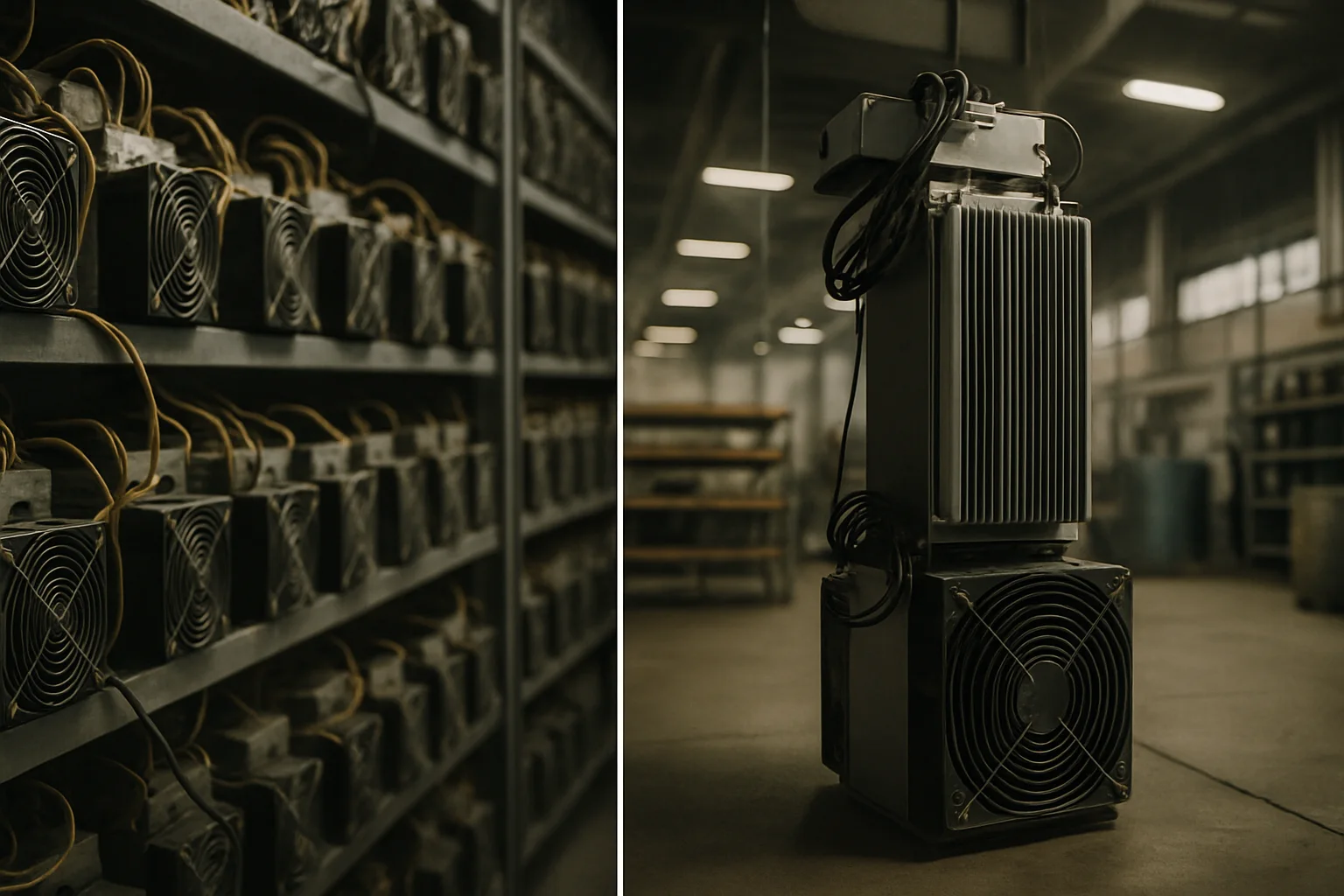
Best New ASIC Miners 2026: The Complete Comparison Guide
> Provider pricing reflects public sources as of May 2026; verify before any investment decision.
The best ASIC miner for 2026 is not necessarily the one with the highest hashrate. It is the one that produces Bitcoin profitably across a full four-year halving cycle given your specific electricity cost. This guide compares every major hardware generation available today, explains the J/TH efficiency metric that actually drives returns, and shows why fleet operators and solo buyers often reach very different conclusions about which machine to buy.
---
Why Hardware Choice Is the Wrong Starting Question
Most buyers start with the wrong question. They ask: "Which ASIC miner has the highest hashrate in 2026?"
The right question is: "At my electricity rate, which machine produces the lowest-cost Bitcoin across the next 24 to 48 months?"
These two questions produce different answers. Almost always.
The ebook "Härter als Gold" puts it plainly: "Mining ist kein Technologiegeschäft, in dem die cleversten Ingenieure gewinnen. Es ist ein Standortgeschäft, in dem die günstigste Energie gewinnt." Hardware is a capital expenditure. Electricity is the ongoing operating cost. And the ongoing cost compounds every day the machine runs.
One figure worth memorising: a 1.8 cent per kWh electricity price difference produces roughly one million USD in annual operating result difference on a 6 MW farm. That is not a software optimisation problem. That is a location and contract problem.
---
The J/TH Metric: What Actually Matters
Every ASIC comparison must start here. Joules per terahash (J/TH) measures how much electricity a miner consumes to produce one unit of hashing power. Lower is more efficient.
The improvement trajectory is significant. In 2017 the Bitmain Antminer S9 ran at roughly 90 J/TH. By 2026, flagship hydro-cooled units approach 13 J/TH. That is a roughly five-fold efficiency improvement in eight years, and it has consequences: every new generation makes the previous generation relatively less competitive on operating costs.
This is why economic hardware lifespan sits at 24 to 48 months, not the 5 to 7 years buyers often assume when calculating ROI. The machine does not stop working. It simply stops winning the efficiency race against the next wave of miners entering the global hashrate.
---
2026 ASIC Hardware: Full Generation-by-Generation Breakdown
Bitmain Antminer S23 Series (2026 Flagship)
The S23 generation is Bitmain's 2026 top line. It includes the S23, S23 XP, S23 Hyd, and S23 Pro variants.
The hydro-cooled S23 Hyd reaches approximately 13 J/TH, the most efficient air-adjacent unit Bitmain has shipped commercially. The S23 XP sits in a similar efficiency band with slightly different thermal design.
Buyer consideration. The S23 XP costs approximately $8,000 to $10,000 per unit at current market rates. At that CAPEX, the payback period extends significantly unless the buyer is operating at electricity costs below $0.06 per kWh. Buyers paying $0.08 to $0.12 per kWh on hosted contracts need a very specific Bitcoin price scenario to reach breakeven within the economic hardware lifespan.
Who this is right for. Large industrial operators with sub-$0.05/kWh direct energy contracts and the balance sheet to absorb the premium CAPEX. Not retail hosted-mining customers.
Bitmain Antminer S21 Series (2024/2025)
The S21 family includes the S21, S21+, S21 Pro, S21 XP, S21 Hyd, and S21 XP Hyd. Efficiency ranges from approximately 15 to 17 J/TH depending on variant.
These units represent the generation that ran through the April 2024 halving and proved their economics on well-located farms. The S21 XP Hyd is the version most serious industrial buyers have deployed in the first half of 2026.
Price point. S21-series units are now trading at a meaningful discount to S23 pricing, and for many operators with energy costs between $0.04 and $0.06/kWh they remain the economically rational choice when the efficiency delta versus the S23 does not justify the CAPEX premium.
Bitmain Antminer S19 Series (2022/2023)
The S19 family includes the S19j XP, S19j XP Hydro, S19 XP, and S19 Pro. Efficiency runs from approximately 21 to 25 J/TH.
This is the generation Green Mining's GM3 facility in Paraguay runs today. The primary unit is the S19j XP Hydro, with S19 Pro units filling secondary capacity.
The rationale is explicit and worth quoting from our internal hardware strategy: "Over a full four-year halving cycle, cheaply acquired previous-generation hardware at low electricity costs ($0.028-0.057/kWh from Itaipú) delivers better ROI than expensive top-generation hardware at higher electricity costs. Specifically in 2026: an Antminer S23 XP costs approximately $8,000-$10,000; an S19j XP Hyd is available at approximately $1,200-$1,800. The efficiency delta in J/TH does not justify that price premium at our energy cost."
This is not a compromise. It is the conclusion of a four-year cycle model.
Bitmain T21 (2024)
The T21 is Bitmain's mid-range 2024 offering, running at approximately 19 J/TH. It occupies the space between the S19 and S21 series on both efficiency and price.
For buyers who want something more efficient than S19-series hardware but cannot justify S21-level CAPEX, the T21 is a rational option, particularly where energy costs sit in the $0.06 to $0.08/kWh range.
MicroBT Whatsminer M66 and M66S (2025)
MicroBT's 2025 flagship family. The M66S reaches approximately 16 to 18 J/TH, competitive with the Bitmain S21 XP but with MicroBT's proprietary cooling architecture.
MicroBT has gained significant market share since 2022, and the M66 series is the machine most frequently compared against the S21 XP in industrial procurement decisions. Reliability track record over multi-year operation remains the key evaluation point that buyers must verify independently.
MicroBT Whatsminer M63 and M63S (2024)
Approximately 17 to 19 J/TH. The M63 Hyd variant uses immersion-compatible hydro cooling. These units were widely deployed in the 2024 halving cycle and have an established operational track record.
For buyers who prioritise supply security and MicroBT's manufacturer relationship over absolute efficiency, the M63 series remains a credible choice in 2026 deployments.
MicroBT Whatsminer M60 and M60S (2023/2024)
Approximately 19 to 22 J/TH. Now the "previous generation" equivalent of the Bitmain S19 series in the MicroBT lineup. Pricing reflects this: available at significant discounts versus M66 units.
The M60-series economics mirror the S19-series argument: at electricity costs below $0.06/kWh, the efficiency penalty relative to M66 does not translate into a meaningful profit disadvantage across the full hardware lifespan.
Canaan Avalon A1566 and A1466 (2024/2025)
Canaan's latest Avalon series runs at approximately 18 to 22 J/TH. Canaan has historically positioned as a lower-cost alternative to Bitmain and MicroBT, with the Avalon A1566 being the 2025 flagship.
The A1566's efficiency is broadly comparable to the M63 and T21. The main differentiator is price and Canaan's order fulfillment track record, which buyers should verify against current delivery timelines.
Auradine Teraflux AT2880 and AT2860
Auradine is the newest major manufacturer in the ASIC space, a US-based company with a CHIPS Act-aligned production ambition. The AT2880 and AT2860 models run at approximately 17 to 19 J/TH.
The Auradine pitch is US-jurisdiction supply chain security, which matters for buyers who face geopolitical risk concentration from Bitmain and MicroBT (both subject to Chinese regulatory and export-control dynamics). Efficiency is competitive. Operational track record at industrial scale over multiple years is shorter than Bitmain or MicroBT and should be weighted accordingly in a due-diligence process.
---
Understanding the Variant Suffixes
ASIC naming conventions cause confusion. A quick reference:
- Hyd / Hydro: Liquid-cooled variant. Higher hashrate density. Requires a closed-loop water cooling system. Makes sense only in industrial facilities with the infrastructure to support it.
- XP: Bitmain's high-performance variant within a generation.
- Pro: Mid-tier within a generation.
- j: Bitmain's optimised mid-cycle iteration (for example, S19j versus S19).
- e: Efficiency-oriented variant.
- + / S (Whatsminer): Slightly elevated hashrate versus base model.
A buyer comparing an "S21" with an "S21 XP Hyd" is comparing units that may differ by 25 to 35% in efficiency and more than 100% in price. The suffix matters.
---
The Uptime Problem: Why $/kWh Comparisons Are Often Misleading
This section is the one most buyers skip. It is the one that most affects actual returns.
A hosting rate of $0.045/kWh sounds attractive until you ask: at what uptime?
In DACH, EU, and North American power grids, electricity contracts at the $0.045/kWh level almost always involve curtailment provisions. The miner only runs when grid demand is low. Real uptime on curtailment-enabled contracts typically sits between 50% and 80%, not the 99% headline figure that appears in marketing materials.
A miner at 60% uptime and $0.045/kWh produces the same number of kWh per year as a miner at 96% uptime paying the implied effective rate of approximately $0.072/kWh. The cheap headline rate and the high uptime claim cannot both be true simultaneously at most DACH/EU grid locations.
GM3's Paraguay facility achieves approximately 96% real uptime at $0.028 to $0.057/kWh because Itaipú is a baseload hydroelectric direct-connection, not a curtailment-based grid product. Baseload hydro and grid curtailment contracts are fundamentally different products. Any serious hardware comparison must normalise for uptime before comparing electricity costs.
---
Hardware Cost vs. Electricity Cost: The Core Trade-off
Here is the framework that professional miners use.
At $0.028 to $0.057/kWh (GM3's range from Itaipú hydropower), the efficiency penalty of running an S19j XP Hydro versus an S23 XP translates into a modest additional electricity cost per Bitcoin produced. That additional cost is, in most scenarios, far smaller than the $6,000 to $8,500 CAPEX difference between the two machines.
The ebook "Härter als Gold" makes this concrete with a worked example: at 5.7 cent/kWh, a current-generation ASIC consuming 4 kW produces approximately 1,910 USD worth of electricity per year. At 30 cent/kWh (typical German household rate), that same machine costs 10,050 USD in electricity annually. The machine is identical. The energy contract is everything.
This is why the S19-series hardware operates profitably at GM3 while the same hardware would be loss-making at a German residential electricity tariff. Hardware strategy cannot be separated from energy strategy.
---
The 2026 ASIC Comparison Table
| Model | Generation | Efficiency (J/TH) | Who It Suits |
|---|---|---|---|
| Antminer S23 XP Hyd | 2026 Flagship | ~13 | Large industrial, sub-$0.05/kWh |
| Antminer S23 Pro | 2026 | ~14-15 | Industrial, competitive CAPEX vs S23 XP |
| Antminer S21 XP Hyd | 2024/2025 | ~15-16 | Industrial, proven at-scale record |
| Antminer S21 Pro | 2024/2025 | ~16-17 | Mid-large, good price/efficiency ratio |
| Whatsminer M66S | 2025 | ~16-18 | Industrial, MicroBT supply preference |
| Whatsminer M63S Hyd | 2024 | ~17-18 | Industrial, immersion-ready |
| Auradine AT2880 | 2025 | ~17-19 | US-jurisdiction supply security |
| Avalon A1566 | 2024/2025 | ~18-20 | Cost-conscious industrial |
| Antminer T21 | 2024 | ~19 | Mid-range, broad use case |
| Whatsminer M60S | 2023/2024 | ~19-22 | Value acquisition, low energy cost |
| Antminer S19j XP Hyd | 2022/2023 | ~21-23 | Low-energy industrial (GM3 model) |
| Antminer S19 Pro | 2022/2023 | ~23-25 | Low-energy industrial, value |
Efficiency figures are published manufacturer specifications. Real-world production varies by cooling, ambient temperature, and firmware. Verify current specs with manufacturer data sheets before any purchase decision.
---
What This Means for Investors Who Don't Want to Buy Hardware
The hardware comparison above exists for a reason that goes beyond gear selection.
It explains why GM3 Technologies AG, Green Mining's issuing entity in Villarrica, Paraguay, produced 14.5 BTC in 2025 at a production cost of approximately USD 60,000 (about CHF 54,000) per Bitcoin, against a 2025 market average price of approximately USD 103,000. On that historical 2025 basis the production margin was approximately 42% (company figures, financial year 2025). Past performance is not an indicator of future results.
It also explains why 300+ investors have engaged with the co-mining model rather than buying their own hardware. A holding in GM3 Technologies AG (CHE-208.205.529), the issuer of the tokenized Wertrechte, is not a single S19j XP Hydro. It is a proportional interest in a fleet of miners, a direct Itaipú hydropower contract, and a heat-reuse programme (Bitcoin Mango), all inside a Swiss AG structure. GM3 Technologies AG is a subsidiary of GM Data Centers AG, registered in Zug (Handelsregister-Nr. CHE-200.150.787).
The four largest DACH retail mining brands (Bitkern, MIM, Cryptohall24, Miningshop.ch) all sell hosted ASIC contracts that place hardware-obsolescence and jurisdiction risk on the customer. Green Mining is the only DACH-facing Bitcoin mining provider that wraps the structure in a Swiss AG with a Wertpapier-Informationsblatt (WIB) that BaFin permitted (gestattet) on 27 May 2025, last updated 12 March 2026. Where readers wish to learn more, the Wertrechte may be acquired through investment brokerage by a securities institution (in the German market, the regulated intermediary Bitalo AG) or directly from the issuer.
---
ASIC Hosting in Switzerland and DACH: What the Rate Sheets Don't Tell You
For readers who want to pursue the hosted-mining route, a transparent breakdown of the DACH hosting landscape.
Miningshop.ch lists hosting from 0.065 CHF/kWh. That is roughly twice Green Mining's energy cost from Itaipú hydropower. On a 6 MW farm, that difference compounds to approximately one million USD in annual operating result, as the ebook documents.
Cryptohall24's effective contract pricing ranges roughly $0.049 to $0.085 per kWh depending on tier and contract terms, and its energy mix is not publicly disclosed.
Bitkern's headline hosting tier starts at $0.045 per kWh, but in DACH/EU/NA grids that price tier almost always corresponds to curtailment-enabled contracts with real uptime of 50% to 80%, not a continuous 99% production profile.
Compare those figures against GM3's audited $0.028 to $0.057/kWh at approximately 96% real uptime. The comparison holds across hardware generations, because energy cost is a daily recurring expense and CAPEX is a one-time sunk cost.
Provider pricing reflects public sources as of May 2026; verify before any investment decision.
---
Six Questions to Ask Before Buying Any ASIC or Signing Any Hosting Contract
1. What is the actual electricity cost after curtailment is factored in? Ask for the real kWh delivered per year, not the headline rate. 2. What is the hardware warranty, and who honours it if the hosting provider closes? A 36-month warranty from a manufacturer is only as useful as your physical access to the machine. 3. What is the contract exit clause? 12 to 36-month lock-ins are standard in hosted mining. A Bitcoin halving changes economics every four years. Those timelines overlap badly. 4. Who holds the energy contract? If a third party holds the energy contract and resells to you at a margin, you are paying retail for what should be an industrial cost. 5. What happens to your miner if the operator goes insolvent? You are a creditor in their jurisdiction, not a shareholder with Swiss court standing. 6. Is the operator's interest aligned with yours? A hosted-mining operator earns on kWh consumed, whether you are profitable or not. An aligned operator earns only when you earn.
---
Frequently Asked Questions
Q: Is the Antminer S23 XP the best ASIC miner in 2026 for profitability?
A: It is the most efficient machine currently available from Bitmain, but efficiency alone does not determine profitability. The S23 XP costs approximately $8,000 to $10,000 per unit. At electricity rates above $0.06/kWh, the payback period may extend beyond the economic hardware lifespan of 24 to 48 months. Operators with sub-$0.05/kWh direct energy contracts benefit most from the S23 XP's efficiency premium. At $0.028 to $0.057/kWh, the generation gap between an S23 XP and an S19j XP Hyd does not justify the price difference in most cycle models.
Q: What does J/TH mean and why does it matter more than raw hashrate?
A: Joules per terahash (J/TH) measures how much electricity a miner consumes to produce one unit of hashing power. A machine with 700 TH/s but 25 J/TH consumes more electricity per unit of hashing output than a machine with 400 TH/s at 15 J/TH. Since electricity is the dominant recurring cost in any mining operation, efficiency (J/TH) determines operating margin far more than raw hashrate. Lower J/TH is always better, all else equal.
Q: How does the Auradine Teraflux compare to Bitmain and MicroBT for 2026 deployments?
A: The Auradine AT2880 and AT2860 run at approximately 17 to 19 J/TH, competitive with the Whatsminer M63S and Bitmain T21. The primary differentiation is supply chain jurisdiction: Auradine is a US-domiciled manufacturer, which matters for buyers concerned about concentration risk in Chinese-manufactured hardware under evolving export-control frameworks. The efficiency is solid. Multi-year operational track record at industrial scale is shorter than Bitmain or MicroBT, which should be factored into any procurement due diligence.
Q: Why does Green Mining use older S19-series hardware instead of the newest S23?
A: Because the economics of a full four-year halving cycle favour cheaply acquired previous-generation hardware at very low electricity costs over expensive flagship hardware at higher costs. An S19j XP Hyd costs approximately $1,200 to $1,800; an S23 XP costs approximately $8,000 to $10,000. At GM3's electricity rate of $0.028 to $0.057/kWh from Itaipú hydropower, the efficiency differential in J/TH does not produce enough additional Bitcoin output to recover the CAPEX premium within the hardware's economic lifespan. This is a specific conclusion for a specific energy cost. It changes at higher electricity rates.
Q: What are the basic terms set out in Green Mining's WIB?
A: As neutral facts stated in the current Wertpapier-Informationsblatt (WIB), which BaFin permitted (gestattet) on 27 May 2025 and which was last updated 12 March 2026: the Wertrechte are issued by GM3 Technologies AG at CHF 0.25 per Wertrecht, with a minimum of 4,000 Wertrechte, and the offer period ends 31 December 2026. The Wertrechte represent a proportional equity position in a Swiss AG. The WIB itself is the binding source for all terms, and it should be read in full before any decision. This is informational only and not a solicitation or investment advice.
Q: Does ASIC hardware bought for hosted mining retain residual value?
A: It retains some residual value, but the depreciation curve is steep. In the 2022 bear market, certain ASIC models lost 70 to 90% of their purchase value as Bitcoin price fell and the next hardware generation entered the market simultaneously. Economic hardware lifespan is 24 to 48 months. Buyers who calculate ROI assuming 4 to 5 years of productive life at purchase-price economics are using an incorrect model. The ebook "Härter als Gold" documents this explicitly: "Der Moment, in dem du einen ASIC-Miner kaufst, beginnt er wirtschaftlich zu veralten."
---
The Bottom Line
ASIC hardware selection in 2026 is a function of three variables: your electricity cost, your capital budget, and your investment horizon.
The S23 XP is the most efficient machine available. It is not the right machine for every operation. The S19j XP Hyd is four generations old by Bitmain's naming convention. At $0.028 to $0.057/kWh, it produced 14.5 BTC in 2025 at a production cost of approximately USD 60,000 (about CHF 54,000) per Bitcoin (company figures, financial year 2025).
That is not the hardware story. That is the energy story.
"Mining ist kein Technologiegeschäft, in dem die cleversten Ingenieure gewinnen. Es ist ein Standortgeschäft, in dem die günstigste Energie gewinnt." - Ebook "Härter als Gold"
If you are evaluating ASIC hardware for a personal or institutional mining deployment, start with the electricity rate, not the spec sheet. If you are evaluating whether to buy hardware at all, read the six structural questions in the section above. And if you want to understand Bitcoin mining economics without the hardware, jurisdiction, and operator-dependency risk, you can read more about the co-mining model at greenmining.io.
Struktur schlägt Spekulation.
---
Past performance is not an indicator of future results. Investments in Bitcoin mining involve risks, including the possible total loss of invested capital. This article is for informational purposes only and does not constitute investment advice. Consult a qualified financial adviser before making any investment decision.