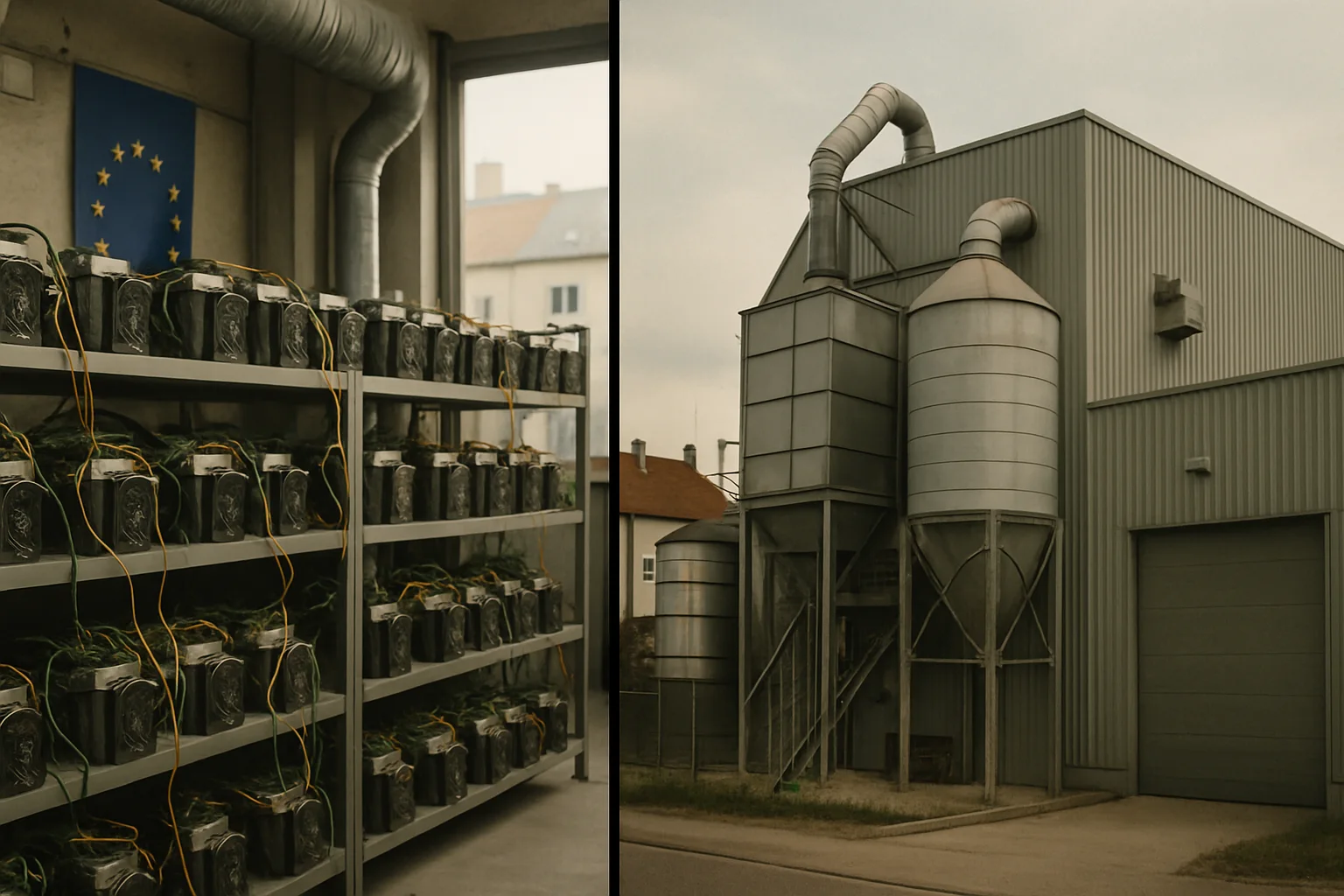
Hosted Bitcoin Mining Providers in Europe: Structural Comparison 2026
European investors entering Bitcoin mining in 2026 face a growing field of providers. This structural comparison covers the relevant options, Bitkern, MIM, Cryptohall24, Miningshop.ch, Compass Mining and Green Mining, against measurable criteria: contract type, energy cost and real delivered uptime, legal vehicle, share tradability and equity upside. Provider prices and conditions reflect public sources as of May 2026; verify any figure on the providers website before making an investment decision.
Why European Investors Are Moving Away From Compass Mining
Compass Mining is the largest US-facing retail hosted-mining brand. For a German, Swiss, or Austrian investor, the product creates three frictions that do not go away regardless of which hosting partner Compass places your miner with.
First, US jurisdiction risk. Your contract is governed by US law, your counterparty is a Delaware entity, and regulatory treatment of Bitcoin mining in the United States has shifted repeatedly since 2022.
Second, currency exposure. A Swiss or German investor paying in CHF or EUR and receiving BTC from a USD-denominated cost structure absorbs FX volatility at the operating level, not just the asset level.
Third, no DACH regulatory hook. There is no BaFin-vetted Wertpapier-Informationsblatt (WIB), no FINMA-rahmen, and no German-language investor relations in the Compass structure. For an investor who expects a regulated financial product, this is a structural gap, not a minor inconvenience.
> "A Compass Mining customer in Switzerland or Germany takes US jurisdiction risk, dollar FX risk, and operator-counterparty risk; Green Mining keeps the contract in Swiss law, the share register in Zug, and the BTC-distribution flow direct." (competitors-dach-detailed.md)
---
The Hosted Mining Model: What You Are Actually Buying
Before comparing providers, it is worth being precise about what hosted mining is.
You buy or rent an ASIC miner. A hosting provider runs it in their facility, charges you for electricity and management, and passes on the Bitcoin output minus those costs.
You are a service-contract counterparty. You are not a shareholder in the operation. Your protection is the contract you signed, nothing more.
This structure has six known failure modes, documented in detail in the source material for this post.
Single-machine risk. One machine going offline means your production drops to zero. A large ASIC fleet absorbs that as a fractional uptime event. You absorb it as a 100% production stop.
Retail electricity rates. The provider negotiates an industrial wholesale rate and bills you at a marked-up rate. According to the ebook "Härter als Gold" Kapitel 7: "Der faktische Strompreis für den Investor liegt bei 8 bis 10 Cent, während der Standort möglicherweise 4 bis 5 Cent zahlt. Die Differenz? Marge des Anbieters." (hosted-mining-vs-us.md)
Operator insolvency risk. If the hosting provider files for insolvency, your miner is physically inside their premises, often subject to a lien or security interest. Recovering the asset takes 6 to 24 months and legal fees. By the time you retrieve it, the next ASIC generation has eroded the residual value.
Misaligned incentives. The ebook states it plainly: "Der Anbieter verdient an drei Dingen: Verkauf der Hardware (oft mit Aufschlag), Strommarge, Servicegebühr. Er verdient, solange deine Maschine läuft, unabhängig davon, ob du Gewinn oder Verlust machst." (hosted-mining-vs-us.md, Ebook Kapitel 7) When Bitcoin falls and your machine is cash-negative, you want to shut down. The operator wants to keep running because they are paid per kWh consumed.
Hardware obsolescence. Economic hardware lifetime is 24 to 48 months. (Ebook Kapitel 4) Your CAPEX depreciates from day one, and you bear that depreciation alone with a single-vintage machine.
Contract rigidity. 12 to 36-month contracts in a market that changes in months. Exit options are often punitive or unavailable.
---
The Leading European Hosted Mining Providers: An Honest Comparison
Bitkern (Zug, Switzerland)
Bitkern is the most prominent DACH-native hosted mining brand, founded in 2017 and operating 85,000+ hosted miners across 18+ data centers globally. Their Swiss HQ in Zug, 4.98-star rating on BTC Echo, and transparent pricing tier table make them the default benchmark for Swiss retail investors.
Hosting rates run from $0.045 to $0.075 per kWh, with 48-month hosting contracts and hardware priced between $2,600 and $4,800 per unit. (competitors-dach-detailed.md)
The structural limits are real. Bitkern's hosting rate of $0.045 to $0.075 per kWh is roughly 30 to 50 percent above Green Mining's Itaipú-hydropower cost of $0.028 to $0.057 per kWh. (competitors-dach-detailed.md) A Bitkern hosting contract locks the customer in for 48 months. And customers bear ASIC depreciation directly, with no equity participation in fleet growth or any future liquidity event.
MIM (Munich International Mining)
MIM is a Munich-based operator with a German-language, education-first approach. Their mining calculators and "Was ist eine Mining Farm" guides help buyers self-qualify. Pricing is not publicly disclosed, which is a friction point for investors who want spreadsheet-able economics before signing a contract.
MIM operates the same hardware-ownership model as every other hosted provider. The buyer carries asset risk, warranty disputes, and jurisdiction risk. MIM cannot match Itaipú-hydropower economics because scale and contract-length determine energy procurement, and MIM's smaller footprint limits both.
Cryptohall24 (Germany)
Cryptohall24 advertises hosting from 4.5 ct/kWh (EUR), which undercuts most DACH competitors on published rate. The legal structure is German, GDPR-compliant, and clearly disclosed.
The concern is the energy mix. 4.5 ct/kWh in EUR is approximately $0.049/kWh, below typical industrial-power rates in most of DACH, and the energy source is not publicly disclosed. Cryptohall24's advertised 4.5 ct/kWh does not disclose its energy mix; Green Mining publishes 100% Itaipú hydropower with a contracted long-term supply. (competitors-dach-detailed.md) Low-cost positioning built on undisclosed energy sourcing is structurally fragile through a halving cycle.
Miningshop.ch (Switzerland)
Miningshop.ch offers CHF-denominated pricing from 0.065 CHF/kWh for Swiss retail investors, with a simple, straightforward product. The Swiss base provides legal comfort. The economics are challenging: Miningshop.ch's 0.065 CHF/kWh is roughly twice Green Mining's energy cost from Itaipú hydropower. (competitors-dach-detailed.md) Operating Bitcoin miners on Swiss retail energy is structurally challenged through halving cycles. Paraguay's surplus-hydropower contracts solve that.
---
The Structural Alternative: Co-Mining Equity in a Swiss AG
Every provider above sells you a service contract. You own a machine (or a contractual claim on a machine's output). You are a vendor's customer, not a co-owner of the operation.
Green Mining (GM Data Centers AG, Dammstrasse 16, 6300 Zug, CHE-200.150.787) operates a different model. You become a registered shareholder in a Schweizer AG, not a service-contract counterparty.
> "You own the data center. The data center produces your Bitcoin." (Product & Tier Concept v1.0, §I)
What the structure actually means for you
You own equity, not a machine. GM3 Technologies AG (CHE-208.205.529) operates a fleet of Bitmain S19j XP Hydro machines at Villarrica, Paraguay, currently 3 MW in operation with up to 6 MW planned. Your investment represents a fractional share of that fleet's output, not a single machine that can fail to zero. (company-knowledge-base.md, §3)
Industrial energy at $0.028 to $0.057 per kWh. GM3 operates on direct hydropower contracts with Paraguay's ANDE, fed by surplus energy from the Itaipú dam. No retail markup, no operator margin on energy. (key-claims-canonical.md, §3)
No margin on energy or hardware. Green Mining's revenue comes from management fees and distributions. The holding wins when the site wins, so the operator's alignment runs in the same direction as the shareholders. (company-knowledge-base.md, §4)
Quarterly BTC distributions direct to your wallet. No intermediary holds your keys. The BTC flows on-chain to the registered shareholder each quarter. 14.5 BTC were produced in 2025. (key-claims-canonical.md, §2)
Swiss legal framework with FINMA framing. Green Mining is the only DACH-facing Bitcoin-mining provider that wraps the offering in a Swiss AG with a BaFin-vetted Wertpapier-Informationsblatt. (competitors-dach-detailed.md) The WIB was gestattet by BaFin on 27 May 2025 and last updated 12 March 2026. AGM voting rights, quarterly reports, and a Swiss Gerichtsstand for shareholder disputes are standard, not premium features.
First tokenized equity on Bitcoin. The shares are issued as tokenized Wertrechte via Taproot Assets, the first tokenized equity on Bitcoin. (company-knowledge-base.md, §5)
---
How the Numbers Compare
The hosted-mining model is not structurally wrong for every investor. The ebook "Härter als Gold" acknowledges this. (hosted-mining-vs-us.md, §6) The question is whether the numbers work in your specific scenario.
Energy cost is the single most important variable in mining economics. Hosting rates across DACH range from 4.5 ct/kWh (Cryptohall24, energy mix undisclosed) to 0.065 CHF/kWh (Miningshop.ch); Green Mining's audited cost from Itaipú hydropower is $0.028 to $0.057 per kWh. (competitors-dach-detailed.md)
In 2025, GM3 produced 14.5 BTC at a production cost of approximately CHF 54,000 per BTC (around USD 60,000), while the market average Bitcoin price was approximately USD 103,000. That is a production margin of approximately 42%. As company results for 2025, GM3 reported revenue of approximately USD 1.77M, EBITDA of approximately USD 566k, and EBIT of approximately USD 286k. (key-claims-canonical.md, §2 and §3)
The facility has been profitable since Q1 2025, with net profit for 2025 of CHF 261,639.52. 300+ investors are currently registered. (key-claims-canonical.md, §2)
A second revenue stream operates independently of Bitcoin price: miner exhaust heat feeds industrial drying chambers for mango, pineapple, and papaya under the Bitcoin Mango brand, which also lowers effective energy costs. (company-knowledge-base.md, §9)
---
The Honest Weaknesses of the Green Mining Model
A comparison post is only credible if it names its own limitations.
Liquidity. Green Mining shares in a Swiss AG are not publicly traded securities. If you need to exit in the short term, this is not the right vehicle.
Investment horizon. This is a long-term asset, best suited to a multi-year horizon. If you need capital back within a year, this is the wrong product.
Drag-along right. Swiss AG shareholder agreements include a standard drag-along clause. If a majority event (IPO, strategic sale) is triggered, minority shareholders can be required to sell alongside the majority. This is disclosed openly because it is part of the truth. (hosted-mining-vs-us.md, §4.8)
Single-asset concentration. GM3 is one site. An investor seeking exposure to multiple mining models could hold a position in hosted mining and a position in Green Mining. The two approaches are not mutually exclusive.
---
Comparison Table: Green Mining vs. European Hosted Mining Providers
| Dimension | Green Mining | Bitkern | MIM | Cryptohall24 | Miningshop.ch | Compass |
|---|---|---|---|---|---|---|
| Product type | Co-mining (Swiss AG equity) | Hosted ASIC | Hosted ASIC | Hosted ASIC | Hosted ASIC | Hosted ASIC |
| Energy source | 100% hydropower (Itaipú) | Mixed, multi-site | Mixed | Undisclosed | Swiss grid | Partner facilities |
| Energy cost | $0.028–0.057/kWh | $0.045–0.075/kWh | n/a | $0.049–0.085/kWh (tier-dependent) | 0.065 CHF/kWh | Varies |
| Hardware risk | Borne by operator (fleet) | Borne by customer | Borne by customer | Borne by customer | Borne by customer | Borne by customer |
| Investor right | Registered Swiss AG shareholder | Service contract | Service contract | Service contract | Service contract | Service contract |
| Regulatory framework | FINMA + BaFin WIB | None | None | None | None | None |
| BTC distributions | Quarterly, direct to wallet | Per machine output | Per machine output | Per machine output | Per machine output | Per machine output |
| Upside on fleet growth | Yes (equity) | No | No | No | No | No |
| Jurisdiction | Swiss law, Zug | Swiss/mixed | German | German | Swiss | US (Delaware) |
(Sources: competitors-dach-detailed.md; company-knowledge-base.md; key-claims-canonical.md)
---
Who Should Choose Which Model
The ebook "Härter als Gold" Kapitel 7 is honest about when hosted mining makes sense. (hosted-mining-vs-us.md, §6)
Hosted mining is defensible if: you want hardware-CAPEX on your balance sheet, you are comfortable operating a single machine, and you want a short horizon before the next hardware generation lands.
The co-mining model fits if: you want fleet exposure rather than single-machine risk, you are investing on a multi-year horizon, and you want the legal framing of a Swiss AG with quarterly BTC distributions and a BaFin-vetted investment document.
The four largest DACH retail mining brands (Bitkern, MIM, Cryptohall24, Miningshop.ch) all sell hosted ASIC contracts that put hardware-obsolescence and jurisdiction risk on the customer. (competitors-dach-detailed.md) Green Mining alone combines equity ownership, an industrial energy contract, and a regulated Swiss framework.
> "Stop buying Bitcoin. Start owning the infrastructure."
---
Frequently Asked Questions
What makes Green Mining structurally different from Compass Mining or Bitkern? Green Mining offers equity in a Swiss AG, not a service contract for a single miner. A shareholder is registered with AGM voting rights, quarterly BTC distributions, and a Swiss Gerichtsstand. Compass and Bitkern customers are service-contract counterparties; their protection is the contract, not a share register.
What does the Green Mining investment vehicle look like? The shares are issued as tokenized Wertrechte on Bitcoin via Taproot Assets, priced at CHF 0.25 per Wertrecht with a minimum of 4,000 Wertrechte per the WIB, and the offer runs until 31 December 2026. These are neutral facts from the Wertpapier-Informationsblatt, not an invitation to invest. Acquisition takes place through investment brokerage at a securities institution or directly from the issuer. For German-market inquiries, Bitalo AG acts as a regulated intermediary. (product-tiers.md, §2; key-claims-canonical.md, §4)
How does Green Mining's energy cost compare to European hosted mining providers? Green Mining operates at $0.028 to $0.057 per kWh via direct hydropower contracts with Paraguay's ANDE, sourced from Itaipú surplus. Bitkern bills at $0.045 to $0.075 per kWh. Miningshop.ch charges 0.065 CHF/kWh, roughly twice Green Mining's cost. Cryptohall24 advertises 4.5 ct/kWh with an undisclosed energy mix. (competitors-dach-detailed.md)
What happens to production if Green Mining's site has a downtime event? GM3 achieved approximately 96% uptime in 2025 and produced 14.5 BTC across the year. Because shareholders own a share of the fleet rather than a single machine, a single-machine failure does not reduce one shareholder's production to zero. Fleet-level downtime is absorbed proportionally across all shareholders.
Is Green Mining regulated? GM Data Centers AG is a Schweizer AG (CHE-200.150.787), registered in Zug under Swiss company law. The BaFin-vetted Wertpapier-Informationsblatt (WIB) was gestattet on 27 May 2025 and last updated 12 March 2026. The tokenized Wertrecht is issued via Taproot Assets; in the German market, acquisition runs through investment brokerage at a securities institution or directly from the issuer, with Bitalo AG acting as a regulated intermediary. (key-claims-canonical.md, §4)
What are the risks of investing in Green Mining vs. hosted mining? Both models carry Bitcoin price risk and operational risk. Green Mining-specific factors include limited liquidity, a drag-along clause in the shareholder agreement, and a long-term investment horizon. Hosted mining carries single-machine failure risk, hardware-obsolescence risk borne by the customer, and counterparty risk if the operator becomes insolvent. The structures are different, not risk-free. Consult a qualified financial or tax advisor before investing.
---
Past performance is not an indicator of future results. Investments in Bitcoin mining carry risk, including the possible loss of the entire capital invested.
---
Sources: hosted-mining-vs-us.md; competitors-dach-detailed.md; company-knowledge-base.md; product-tiers.md; key-claims-canonical.md; voice-guide.md; Ebook "Härter als Gold" Kapitel 3, 4, 7, 10; GM3 KPI Reporting 12/2025; WIB 27.5.2025 (BaFin-gestattet).