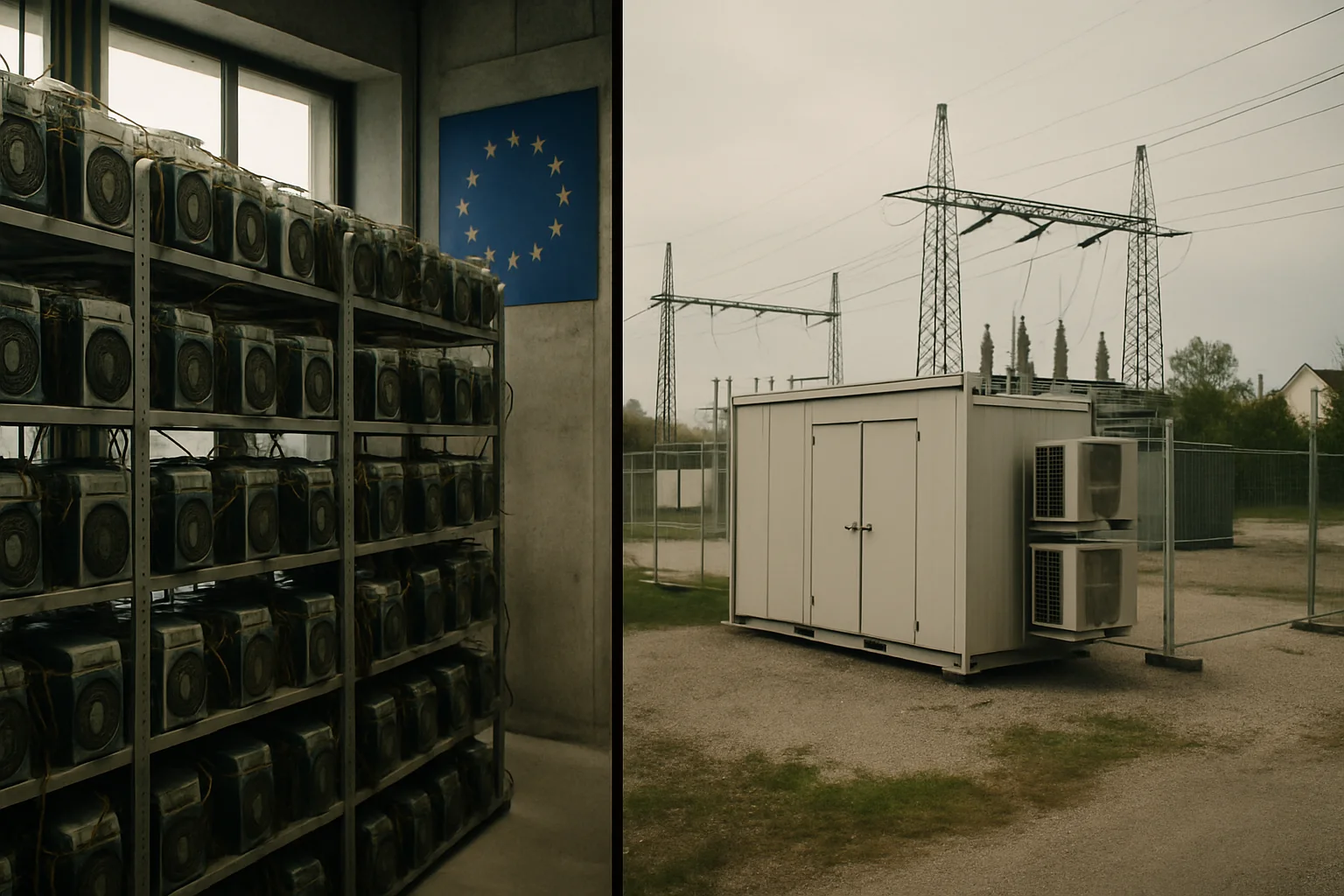
Best Bitcoin Mining Investment Providers in Europe 2026
When DACH investors search for the best Bitcoin mining providers in 2026, they typically encounter comparison articles written by hosting operators ranking themselves. This article applies a different framework: not "which hosting service is cheapest," but "which provider gives you the strongest investor position." Six providers, six criteria, one methodology. The results follow the logic, not the marketing.
---
Why the Ranking Criteria Matter More Than the Ranking
Bitcoin mining is not a single product. It is a category with fundamentally different legal structures, risk profiles, and economic alignments depending on which provider you choose.
A hosted-mining customer and a Green Mining shareholder both receive Bitcoin related to mining operations. But one holds a service contract; the other holds registered equity in a Swiss AG. Those are not comparable investments in any meaningful sense.
The six criteria used in this ranking were selected because they define what actually happens to your capital when Bitcoin price drops 40 percent, when a halving compresses margins, or when a hosting operator faces insolvency.
Criteria applied:
1. Legal structure (equity vs. service contract) 2. Energy cost and transparency (audited source and per-kWh figure) 3. Operator alignment (does the operator profit when you lose?) 4. Regulatory framework (FINMA, BaFin, or neither) 5. Tradeability (can you exit before the contract ends?)
---
The Six Providers
1. Green Mining (GM Data Centers AG)
Headquarters: Zug, Switzerland (CHE-200.150.787) Model: Co-mining via direct shareholding in a Swiss AG Energy source: 100% hydropower from Itaipú, Paraguay (ANDE contracts) Energy cost: $0.028 to $0.057 per kWh (Knowledge Base 2026, §3) Regulatory framework: Swiss AG, FINMA-rahmen, BaFin-approved WIB (gestattet 27.5.2025)
Green Mining is the only DACH-facing Bitcoin mining provider that wraps the offering in a Swiss AG with a BaFin-vetted Wertpapier-Informationsblatt. (competitors-dach-detailed.md, positioning anchors)
Every investor becomes a registered shareholder in GM3 Technologies AG, with AGM voting rights, quarterly reports, and quarterly Bitcoin distributions sent directly to their own wallet. No custody intermediary. No operator-controlled key.
The operator alignment is structural, not contractual. GM Data Centers AG (the holding) owns approximately 40 percent of GM3 and takes no margin on energy or hardware. Revenue for the holding comes from management fees and distributions, meaning the holding wins only when the site wins. (Knowledge Base 2026, §2)
GM3 produced 14.5 BTC in 2025, at a production cost of approximately CHF 54,000 per BTC against a market average of approximately USD 105,000. The site has been profitable since Q1 2025, with a 2025 EBIT margin of +17.5 percent and an average investor ROI of approximately +10 percent per annum in BTC terms, with early investors reaching +20 percent. (Key Claims Canonical, §2; Knowledge Base §4)
Wertrechte are tradeable after a 12-month Sperrfrist, with a secondary market planned for H2 2026. The investor base now counts 300+ registered shareholders across all sites.
A second revenue stream exists independent of Bitcoin price: miner exhaust heat (70 to 80 degrees Celsius) feeds industrial drying chambers for mango, pineapple, and papaya, reducing effective energy cost by 10 to 30 percent. (Knowledge Base §2)
Weaknesses to acknowledge:
- Shares are not liquid until the planned secondary market opens in H2 2026.
- A drag-along right (Mitverkaufsverpflichtung) exists: in a majority sale event, minority shareholders can be compelled to participate. This is standard in Swiss AG structures and is disclosed openly. (hosted-mining-vs-us.md, §4.8)
- The five-plus-year time horizon suits long-term holders. Investors needing capital in under 12 months should not enter.
Criteria scores: Legal structure: equity. Energy: audited, 100% hydro, $0.028 to $0.057/kWh. Operator alignment: fully aligned (no margin on energy or hardware). Regulatory: FINMA + BaFin-WIB. Tradeability: yes (after 12 months). Min ticket: CHF 1,000.
---
2. Bitkern
Headquarters: Zug, Switzerland (Gotthardstrasse 26) Model: Hosted ASIC mining (two tiers: LITE retail, PRO institutional) Energy cost: $0.045 to $0.075 per kWh Regulatory framework: None
Bitkern is the strongest DACH retail mining brand after eight years in market. Their scale claim of 85,000+ hosted miners across 18+ data centers is significant. The Trustpilot and BTC Echo ratings (4.5 and 4.98 stars respectively) indicate operational credibility. (competitors-dach-detailed.md, Bitkern profile)
Bitkern's hosting rate of $0.045 to $0.075 per kWh is roughly 30 to 50 percent above Green Mining's Itaipú-hydropower cost of $0.028 to $0.057 per kWh. At the scale of a 6-MW farm, the margin difference between those two electricity bands is the difference between profitability through a halving cycle and shutting down.
The 48-month contract lock-in is the most investor-restrictive term in this comparison. Bitcoin mining economics can shift substantially over four years. A customer entering a Bitkern contract in mid-2026 commits through mid-2030, across at least one more halving event (expected 2028) and without a clear exit mechanism.
Bitkern customers bear ASIC depreciation directly. The economic hardware lifetime of an S19-generation machine is 24 to 48 months (hosted-mining-vs-us.md, §3.3; Ebook Kapitel 4). On a 48-month contract, the customer experiences the full obsolescence curve on a single-vintage machine with no fleet rotation.
The multi-site structure ("18+ data centers") offers operational diversification at the operator level but creates opacity at the investor level: the customer cannot easily audit which jurisdiction holds their specific miner, what the energy mix is, or what curtailment risk looks like at each site.
Where Bitkern fits: Investors who want a recognizable Swiss-based brand, are comfortable with service-contract structure, and have a tolerance for single-machine risk over a four-year horizon.
Criteria scores: Legal structure: service contract. Energy: $0.045 to $0.075/kWh, mix undisclosed. Operator alignment: misaligned (operator earns on kWh consumed regardless of investor profit). Regulatory: none. Tradeability: no (48-month lock-in). Min ticket: ~USD 2,600 (1 ASIC).
---
3. MIM Munich International Mining
Headquarters: Munich, Germany Model: Bitcoin mining hosting, ASIC sales, mining consulting Energy cost: Not publicly disclosed (request-a-quote) Regulatory framework: None
MIM occupies the personal-service end of the DACH market. Their education content (mining calculators, "Was ist eine Mining Farm" guides) is genuinely useful for first-time buyers and builds trust with a German-speaking audience. The team visibility on the site is a positive signal.
The request-a-quote pricing model is a friction point for investors who want to run spreadsheet-level due diligence before making contact. Sophisticated DACH investors in the CHF 25,000 to 100,000 range typically want published economics before a call. (competitors-dach-detailed.md, MIM profile)
The structural critique is the same as for any hosted-mining provider: each customer buys a single machine, carries hardware-obsolescence risk, and holds a service contract rather than equity. There is no BaFin-vetted WIB and no Swiss AG structure.
MIM operates at smaller scale than Bitkern, which limits their ASIC procurement leverage and energy contract negotiating power. They cannot match Itaipú-hydropower economics.
Where MIM fits: German investors who value personal onboarding, want native DACH-language service, and are willing to exchange pricing transparency for relationship.
Criteria scores: Legal structure: service contract. Energy: undisclosed. Operator alignment: misaligned (same structural incentive as all hosted-mining). Regulatory: none. Tradeability: n/a. Min ticket: undisclosed.
---
4. Cryptohall24
Headquarters: Germany Model: ASIC miner hosting Energy cost: From 4.5 ct/kWh EUR (approximately $0.049/kWh), energy mix undisclosed Regulatory framework: German legal structure, GDPR-compliant
Cryptohall24 publishes the most aggressive low-cost positioning in DACH retail mining: 4.5 ct/kWh undercuts most competitors on advertised rate. That headline number appeals to investors who are optimizing primarily on electricity cost.
The critical caveat: 4.5 ct/kWh is below standard industrial-power rates across most of DACH. The energy mix is not disclosed. Green Mining publishes its 100% Itaipú-hydropower source with a contracted long-term supply and a public Itaipú-generated provenance. (competitors-dach-detailed.md, Cryptohall24 profile)
Sustainability signal is weak by comparison, and 48 percent of Green Mining's own investors cite sustainability as a top investment reason (Key Claims Canonical, §6). For investors for whom the energy source matters, Cryptohall24 offers no verifiable answer.
The low-cost operator in any commodity business is also typically the most exposed when margins compress. When the 2028 halving reduces block reward to 1.5625 BTC per block (after the 2024 halving to 3.125 BTC), the operators with the thinnest margins and least transparent energy contracts face the largest structural pressure.
Where Cryptohall24 fits: Price-sensitive investors who are comfortable with German-jurisdiction service contracts and do not require energy-source transparency or regulatory framing.
Criteria scores: Legal structure: service contract. Energy: ~4.5 ct/kWh, mix undisclosed. Operator alignment: misaligned. Regulatory: none beyond standard German commercial law. Tradeability: n/a. Min ticket: 1 ASIC.
---
5. Miningshop.ch
Headquarters: Switzerland Model: Hosted ASIC mining for Swiss retail Energy cost: From 0.065 CHF/kWh Regulatory framework: None beyond Swiss commercial law
Miningshop.ch serves risk-averse Swiss investors who want a local counterparty in CHF. The CHF-denominated pricing is transparent and easy to model. The Swiss address offers comfort for investors who associate geography with trust.
The economic challenge is mathematical. Miningshop.ch's 0.065 CHF/kWh is roughly twice Green Mining's energy cost from Itaipú hydropower (competitors-dach-detailed.md, Miningshop.ch profile). Operating Bitcoin miners on Swiss retail energy rates is structurally difficult through a halving cycle. When the next halvings compress block rewards further, the high-electricity-cost operators face a viability question that lower-cost providers do not.
Swiss electricity rates are among the highest in Europe for industrial consumers, which creates a structural ceiling on how competitive a Swiss-hosted mining service can be against international hydropower-contract operators.
Where Miningshop.ch fits: Swiss investors who specifically require a CHF-denominated, Switzerland-based counterparty and accept the energy-cost premium as the price of that proximity.
Criteria scores: Legal structure: service contract. Energy: 0.065 CHF/kWh (~2x Green Mining cost). Operator alignment: misaligned. Regulatory: none. Tradeability: n/a. Min ticket: 1 ASIC.
---
6. Compass Mining
Headquarters: Delaware, USA Model: Hosted mining marketplace (buy a miner, Compass places it in a partner data center) Energy cost: Variable per hosting partner Regulatory framework: US regulatory framework (no BaFin, no FINMA)
Compass is the default benchmark that German and Swiss investors encounter when researching hosted mining. The brand is prominent and the model is well-documented. For DACH investors, however, several structural factors create friction.
A Compass Mining customer in Switzerland or Germany takes US jurisdiction risk, US dollar FX risk, and operator-counterparty risk simultaneously. The share register is in the US, the legal system is US, and any dispute resolution happens under US law. (competitors-dach-detailed.md, Compass profile)
Compass's 2022 to 2023 turbulence around hosting-partner failures made the German Bitcoin community wary. The marketplace model means Compass itself is not the operator: the customer's miner sits in a partner facility, introducing a second counterparty in the chain.
There is no BaFin-vetted Wertpapier-Informationsblatt, no FINMA-rahmen, and no German-language investor relations infrastructure. For the DACH investor who values regulatory framing, Compass offers none of these.
Where Compass fits: Technically literate investors who want hardware ownership, are comfortable with US-jurisdiction service contracts, and do not require DACH regulatory framing.
Criteria scores: Legal structure: service contract. Energy: variable, partner-dependent. Operator alignment: misaligned. Regulatory: US only, no BaFin or FINMA. Tradeability: limited secondary market for hardware. Min ticket: 1 ASIC.
---
Comparative Scoring Table
| Criteria | Green Mining | Bitkern | MIM | Cryptohall24 | Miningshop.ch | Compass |
|---|---|---|---|---|---|---|
| Legal structure | Equity (Swiss AG) | Service contract | Service contract | Service contract | Service contract | Service contract |
| Energy cost | $0.028-0.057/kWh | $0.045-0.075/kWh | Undisclosed | $0.049-0.085/kWh (tier-dependent) | ~$0.071/kWh | Variable |
| Energy source transparency | 100% hydro, audited | Multi-site, mixed | Undisclosed | Undisclosed | Swiss grid | Partner-dependent |
| Operator alignment | Full (no margin on energy/hardware) | Misaligned | Misaligned | Misaligned | Misaligned | Misaligned |
| Regulatory framework | FINMA + BaFin WIB | None | None | None | None | US only |
| Tradeability | Yes (after 12 mo.) | No (48-mo. lock-in) | n/a | n/a | n/a | Limited |
| Min ticket | CHF 1,000 | ~USD 2,600 | Undisclosed | 1 ASIC | 1 ASIC | 1 ASIC |
| Hardware risk | Borne by operator | Borne by customer | Borne by customer | Borne by customer | Borne by customer | Borne by customer |
| Equity upside on fleet growth | Yes | No | No | No | No | No |
---
The Structural Argument in One Paragraph
The four largest DACH retail mining brands (Bitkern, MIM, Cryptohall24, Miningshop.ch) all sell hosted ASIC contracts that put hardware-obsolescence and jurisdiction risk on the customer. (competitors-dach-detailed.md, composite quotes) In each case, the operator's business model earns revenue from electricity mark-up, hardware sales, and management fees, regardless of whether the investor is profitable. That creates a conflict at the structural level: when Bitcoin price falls below the investor's break-even, the investor wants to stop; the operator has every financial reason to keep running. Green Mining earns no margin on energy or hardware. The holding's distributions come from the same profit pool as the investor's BTC dividends. Interests are aligned, not opposed.
---
Eight Data Points Worth Remembering
1. Green Mining produced 14.5 BTC in 2025 at a production cost of approximately CHF 54,000 per BTC, against a market average of approximately USD 105,000. (Knowledge Base §4; GM3 KPI Reporting 12/2025)
2. Bitkern's hosting rate of $0.045 to $0.075 per kWh is 30 to 50 percent above Green Mining's Itaipú-hydropower cost of $0.028 to $0.057 per kWh. (competitors-dach-detailed.md)
3. A 1.8 cent-per-kWh electricity cost difference translates to approximately USD 1,000,000 annual result difference on a 6-MW mining farm. (hosted-mining-vs-us.md, §5)
4. GM3's uptime in 2025 was approximately 96 percent, across 600+ active ASICs at the Villarrica, Paraguay site. (Knowledge Base §3)
5. 48 percent of Green Mining investors cite sustainability as a top investment reason; Cryptohall24 and MIM do not disclose their energy mix. (Key Claims Canonical, §6; GM3 Investor Survey Oct 2025)
6. The 2024 Bitcoin halving reduced the block reward to 3.125 BTC. The next halving, expected in 2028, will reduce it to 1.5625 BTC. Operators with the highest energy costs face the largest structural compression at each halving. (public record; IEA global electricity market reports)
7. Green Mining's BaFin WIB was approved on 27 May 2025, making it the only DACH-facing Bitcoin mining investment vehicle with this regulatory standing. (WIB 27.5.2025; Key Claims Canonical, §4)
8. 61 percent of Green Mining investors hold for more than five years, per the GM3 Investor Survey (October 2025, n=79). (Key Claims Canonical, §6)
---
Who Should Look at What
| Investor profile | Best fit |
|---|---|
| CHF 1,000 to 10,000, first mining exposure, 5+ year horizon | Green Mining Invested Explorer tier |
| Wants a recognized Swiss hosting brand, comfortable with 48-month lock-in | Bitkern |
| Values personal DACH-language onboarding, smaller ticket | MIM |
| Price-sensitive, German counterparty, no regulatory requirement | Cryptohall24 |
| Swiss-only counterparty required, accepts energy-cost premium | Miningshop.ch |
| US-market familiarity, comfortable with US jurisdiction and USD exposure | Compass |
The decision is not "which provider is best in absolute terms." It is which legal structure, energy cost, and alignment model fits your investment criteria. When those criteria are laid out clearly, the structural differences become self-evident.
---
Frequently Asked Questions
What is the difference between hosted mining and co-mining? In hosted mining, you buy or rent a specific ASIC machine and receive its Bitcoin output minus electricity and hosting fees. You hold a service contract. In co-mining (Green Mining's model), you buy shares in a Swiss AG that owns and operates an entire fleet of mining machines. You hold equity, receive quarterly BTC distributions, and participate in any fleet-level upside, including hardware reinvestment and site expansion.
Why does energy cost matter so much in Bitcoin mining? Energy is the dominant ongoing operating cost in any mining operation. Hardware is a one-time capital outlay; electricity is a recurring expense that determines whether a site remains profitable through halving cycles. A site producing at $0.028 to $0.057 per kWh (Green Mining, from Itaipú hydropower) has a structurally different break-even than one operating at $0.065 to $0.075 per kWh. As block rewards halve every four years, the operators with the lowest energy costs survive; others do not. The ebook "Härter als Gold" states it plainly: "Wer den günstigsten Strom hat, gewinnt den Wettbewerb."
What does BaFin WIB approval mean for a German investor? A Wertpapier-Informationsblatt (WIB) is a standardized investment information document approved by BaFin, the German financial regulator. It is required for the public offer of certain investment products in Germany. Green Mining's WIB was approved on 27 May 2025, permitting the public offering of Green Mining Wertrechte to German retail investors. No other DACH-facing Bitcoin mining provider holds equivalent documentation. The minimum acquisition is 4,000 Wertrechte at CHF 0.25 each (CHF 1,000 total).
What happens to my investment if Green Mining's operator faces financial difficulty? Green Mining investors are registered shareholders in GM3 Technologies AG, a Swiss AG with its own balance sheet, its own liquidity, and its own Handelsregister entry. If the holding (Green Mining) were to face difficulty, GM3's assets and operations exist as a separate legal entity. In contrast, hosted-mining customers hold service contracts: if the operator files for insolvency, the customer's machine is physically inside the operator's premises, often subject to the insolvency administrator's authority. Swiss AG shareholder rights offer a structurally different level of protection than a service contract in a foreign jurisdiction.
Can Green Mining investors exit before the planned secondary market? During the 12-month Sperrfrist, shares are not tradeable. After month 13, Wertrechte can be traded. A formal secondary market is planned for H2 2026. For investors who may need liquidity within 12 months of entry, this is a constraint that should inform the investment decision. Green Mining discloses this openly.
How does the halving affect each provider's economics? The April 2024 halving reduced the block reward to 3.125 BTC per block. The next halving, expected in 2028, will reduce it to 1.5625 BTC. Providers with low energy costs (Green Mining at $0.028 to $0.057 per kWh) have a larger buffer before they reach the cash break-even threshold. Providers operating at Swiss retail electricity rates (Miningshop.ch at 0.065 CHF/kWh) or at the upper end of DACH hosting rates (Bitkern at up to $0.075/kWh) have materially thinner margins when block rewards compress. Energy cost is not a secondary consideration; it is the primary determinant of halving-cycle survival.
---
Past performance is not an indicator of future results. Investments in Bitcoin mining carry risks, including the possible total loss of invested capital. This article is for informational purposes only and does not constitute investment advice. Consult a qualified financial advisor before making any investment decision.