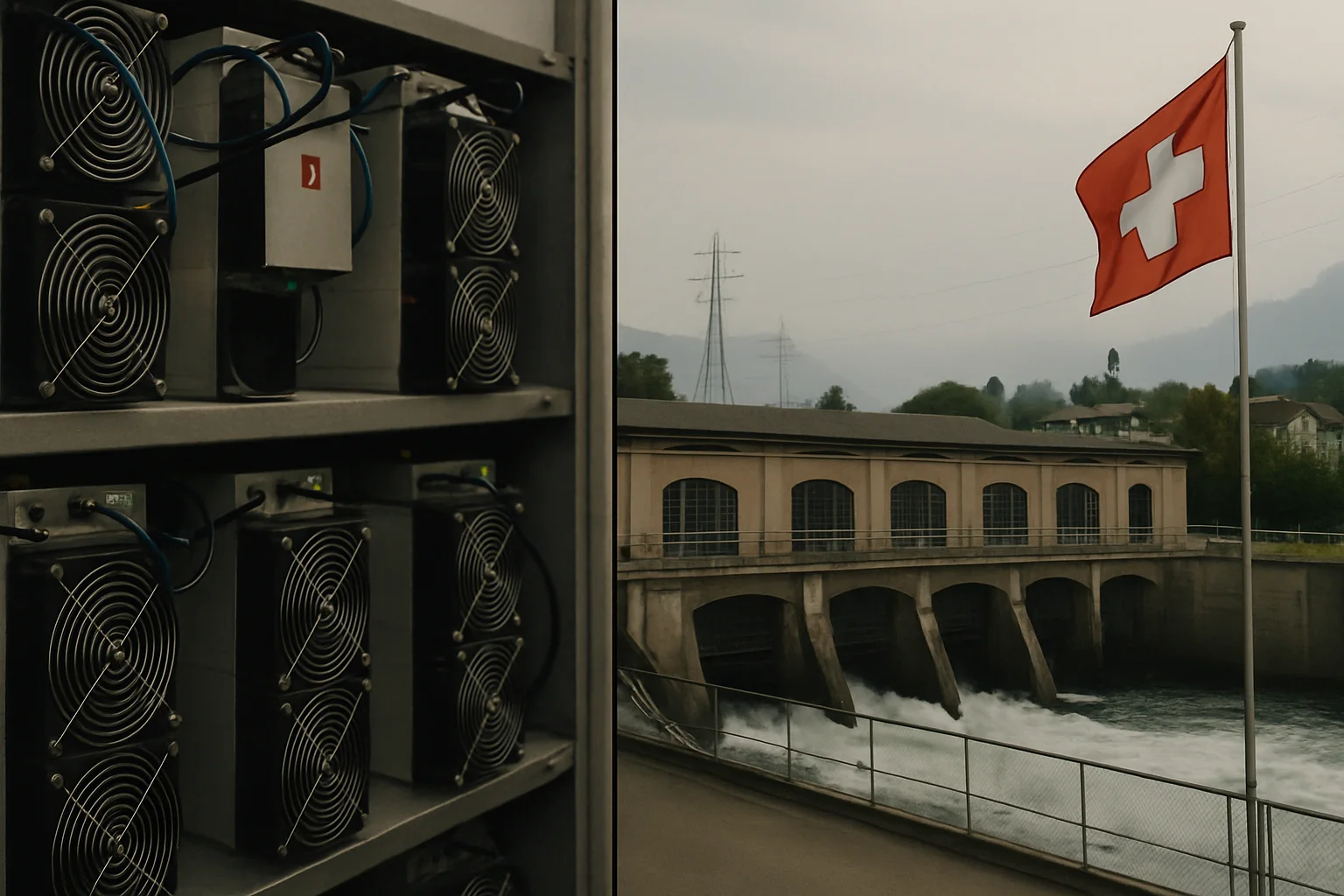
Bitcoin Mining Switzerland: Is It Still Profitable in 2026?
Bitcoin mining in Switzerland is not automatically profitable in 2026. It depends almost entirely on one variable: your electricity price. Swiss residential power costs between CHF 0.25 and CHF 0.35 per kWh, which puts solo home mining firmly in the red. Operators who access industrial-scale hydropower at $0.028 to $0.057/kWh tell a different story entirely.
---
Why Electricity Price Is the Only Number That Matters
Mining profitability is not a fixed output. It is a function of three inputs: hardware efficiency, Bitcoin's network difficulty, and, most critically, the cost of electricity.
Every other variable is either shared across all miners globally or solved by buying the right machine. Energy cost is the one factor where geographic and structural decisions create lasting competitive advantage.
Swiss Residential Power: A Structural Disadvantage
Swiss households pay some of the highest electricity prices in Europe. According to the International Energy Agency, average residential electricity prices in Switzerland exceeded CHF 0.28/kWh in 2024, with many cantons charging significantly more after grid fees and taxes are applied.
Run those numbers through any standard Bitcoin mining profitability calculator: a modern ASIC drawing 3,500 W at CHF 0.30/kWh generates monthly electricity costs of roughly CHF 2,520, before hardware depreciation or network difficulty increases.
At the current post-halving block reward of 3.125 BTC per block, and with global hash rate near all-time highs, a single home miner in Switzerland cannot compete. The math does not close.
> "Swiss residential electricity at CHF 0.28 to 0.35/kWh makes solo home mining economically unviable against industrial operators running at $0.028 to $0.057/kWh."
---
The April 2024 Halving Changed the Baseline
The Bitcoin halving of April 2024 cut the block subsidy from 6.25 BTC to 3.125 BTC. This event reset the profitability threshold for every miner on the planet.
Miners with high electricity costs were pushed below breakeven almost immediately. Miners with structural energy advantages absorbed the impact and continued to operate profitably.
> "Post-halving, only miners operating below approximately $0.05/kWh can sustain positive operating economics without relying on Bitcoin price appreciation alone."
This is not speculation. It reflects the basic arithmetic of revenue (BTC price x coins mined) versus operating expenditure (watts consumed x electricity rate x hours operated).
---
What Industrial Mining in Paraguay Actually Costs
GM Data Centers AG is headquartered in Zug, Switzerland, and operates active mining infrastructure in Paraguay, a country where abundant hydropower from the Itaipu dam produces electricity at some of the lowest wholesale rates in the world.
Our operating electricity cost sits within the $0.028 to $0.057/kWh range. That is five to ten times cheaper than Swiss residential power.
At $0.04/kWh, the midpoint of our range, a large-scale hydro-powered operation generates meaningfully positive cash flow at typical Bitcoin prices. The same installation in a Swiss data center at CHF 0.28/kWh would operate at a loss.
> "Running equivalent hash rate at $0.04/kWh versus CHF 0.30/kWh produces a large cost differential, which determines whether the same machine generates profit or loss."
100% Hydropower: The Regulatory and ESG Dimension
All of our Paraguay operations run on 100% hydropower. This is not a marketing claim. It reflects the actual energy mix of the national grid in the regions where we operate, verified by the source infrastructure.
For Swiss and international readers evaluating assets through a sustainability lens, this matters. Global electricity sector data from the IEA confirms that hydropower remains the largest source of low-carbon electricity worldwide, and Paraguay exports the majority of its generation capacity precisely because domestic consumption is low.
> "Paraguay's hydropower-dominant grid allows Bitcoin miners to operate at near-zero carbon intensity per hash, a structural ESG advantage over coal or gas-powered competitors."
---
Real Operational Data: What Our Numbers Show
Greenmining.io is not a theoretical model. More than 300 investors currently participate in our mining infrastructure, and our operational data reflects real-world output, not backtested projections.
Key company figures from 2025 operations:
- Electricity cost: $0.028 to $0.057/kWh (hydropower, Paraguay)
- Block reward: 3.125 BTC (post-April 2024 halving)
- BTC produced in 2025: 14.5 BTC
- Capacity: 3 MW currently in operation, up to 6 MW planned
- Uptime 2025: approximately 96%
- 2025 company results (GM3): revenue approximately USD 1.77M, EBITDA approximately USD 566k, EBIT approximately USD 286k
- 2025 EBIT margin (company): +17.5%
- Net profit 2025: CHF 261,639.52
> "In 2025, our Paraguay operations produced 14.5 BTC and reached a +17.5% EBIT margin at company level, driven primarily by the structural electricity cost advantage of hydropower-sourced energy. Past performance is not an indicator of future results."
These figures come from an operating Swiss AG, a company domiciled in Zug, subject to Swiss corporate law, with auditable accounts. They describe the company's own 2025 results and are not a forecast or a promise of any investor return.
---
Switzerland as a Legal and Structural Domicile
Being Swiss matters beyond the flag on the letterhead.
Switzerland has a mature, rule-of-law corporate environment. A Swiss AG (Aktiengesellschaft) provides a recognizable, enforceable legal structure. The Swiss Financial Market Supervisory Authority (FINMA) sets the broader regulatory context, and Swiss corporate governance norms apply.
For international readers evaluating Bitcoin mining exposure, a Swiss-domiciled operating company offers a level of structural clarity that offshore vehicles or anonymous protocols cannot.
> "Switzerland's Zug canton has established itself as one of Europe's leading crypto-corporate jurisdictions, with many serious blockchain firms choosing Swiss AG structures for their legal clarity."
---
Mining vs. Hodl vs. Bitcoin ETF: An Honest Comparison
Investors evaluating Bitcoin exposure in 2026 face a genuine decision tree. Here is a direct assessment of the three main routes:
Option 1: Buy and Hold Bitcoin (Hodl)
- Simple, liquid, fully correlated to BTC price
- No yield, no operational exposure, no structural cost advantage
- Subject to exchange counterparty risk, custody complexity for large positions
Option 2: Bitcoin Spot ETF or ETP
- Regulated, liquid, accessible via standard brokerage accounts
- Management fees (typically 0.20 to 1.50% annually) with no upside from mining economics
- Pure price exposure, no differentiation from network participation
Option 3: Industrial Mining via a Swiss-Structured Operator
- BTC produced at below-market cost of production
- Operational exposure to Bitcoin economics rather than direct price speculation
- Illiquid relative to ETFs
- Company operating margins depend on controlled electricity costs and can vary with the Bitcoin price
> "An operator with $0.04/kWh electricity cost produces Bitcoin at a structural discount to spot price, a dynamic unavailable to ETF or spot buyers. Past performance is not an indicator of future results."
None of these options is universally superior. The right answer depends on liquidity needs, tax position, and risk tolerance.
---
Bitcoin Mining Profitability Calculator: The Key Inputs for 2026
If you want to model mining profitability yourself, the inputs that matter most in 2026 are:
1. Hardware efficiency (J/TH). Newer ASICs such as the Bitmain S21 Pro and MicroBT Whatsminer M66S run in the region of 15 to 17 J/TH 2. Electricity cost ($/kWh). The single largest variable. Everything below $0.06/kWh is potentially viable post-halving 3. Network difficulty, currently near all-time highs. Adjust upward in your model 4. Bitcoin price assumption. Use a range, not a single number. Model at $60,000, $80,000, and $100,000 5. Pool fees, typically 1 to 2% of gross mining revenue 6. Hardware depreciation. ASICs have a 3 to 5 year effective lifespan under continuous operation
Standard mining calculators allow you to stress-test these inputs. The consistent finding: at CHF 0.28/kWh or above, Swiss home mining does not work in 2026. At $0.028 to $0.057/kWh with modern hardware, it does.
> "According to Statista, Bitcoin mining's global electricity consumption exceeded 140 TWh annually by 2024, a scale that confirms the industry has moved permanently toward institutional, low-cost energy operators." (Source)
---
How the Green Mining Structure Works
GM Data Centers AG mines Bitcoin with hydropower in Paraguay through a Swiss-domiciled operating company. The tokenized equity (Wertrechte) is issued by its subsidiary GM3 Technologies AG on Bitcoin via Taproot Assets.
As neutral reference facts from the published Wertpapier-Informationsblatt (WIB), which BaFin gestattet on 27 May 2025 and which was updated on 12 March 2026: each Wertrecht is priced at CHF 0.25, with a minimum of 4,000 Wertrechte, and the offer ends on 31 December 2026. Acquisition takes place, in the words of the WIB, "im Wege der Anlagevermittlung bei einem Wertpapierinstitut oder direkt bei der Emittentin." In the German market, Bitalo AG acts as a regulated intermediary for this.
The underlying asset, Bitcoin, is real and auditable on-chain. The operating company, a Swiss AG, is real and auditable under Swiss law. Anyone who wants to understand the terms should read the WIB in full and consult a qualified adviser.
---
Frequently Asked Questions
Q: Is Bitcoin mining still profitable in Switzerland in 2026? A: Not for home miners. Swiss residential electricity prices of CHF 0.25 to 0.35/kWh make solo mining unprofitable after the April 2024 halving cut block rewards to 3.125 BTC. Profitability in 2026 requires access to industrial electricity below approximately $0.06/kWh, a threshold only achievable at scale in low-cost energy markets.
Q: What is the cheapest electricity for Bitcoin mining? A: Industrial hydropower electricity is available at $0.028 to $0.057/kWh at operations such as those run by GM Data Centers AG in Paraguay. This compares to CHF 0.28 to 0.35/kWh for Swiss residential power.
Q: How does Bitcoin mining compare to buying a Bitcoin ETF in 2026? A: A Bitcoin ETF gives pure price exposure with management fees and full liquidity. Industrial mining through a Swiss AG gives exposure to Bitcoin produced at below-spot cost of production, but with lower liquidity. They serve different investor profiles. Past performance is not an indicator of future results.
Q: What happened to Bitcoin mining profitability after the April 2024 halving? A: The halving reduced the block subsidy from 6.25 BTC to 3.125 BTC, effectively halving mining revenue per block. Miners with low electricity costs absorbed this and remained profitable. High-cost miners, including most Swiss residential miners, were pushed below breakeven unless Bitcoin's price rose sufficiently to compensate.
Q: How can I learn more about participating in greenmining.io's operations? A: The terms of the tokenized equity are set out in the published Wertpapier-Informationsblatt (WIB). Read the WIB in full and consult a qualified financial and legal adviser before making any decision. In the German market, Bitalo AG acts as a regulated intermediary.
Q: Is hydropower-based Bitcoin mining considered ESG-compliant? A: Operations powered by 100% hydropower produce near-zero direct carbon emissions per Bitcoin mined. While ESG classification depends on an investor's specific framework and jurisdiction, hydropower-sourced mining sits at the low end of the environmental impact spectrum for Bitcoin production, supported by IEA data on hydropower's carbon intensity profile.
---
Past performance is not an indicator of future results. This content is provided for informational purposes only and does not constitute investment advice, a solicitation, or an offer to buy or sell any financial instrument. Investments in mining operations involve risk, including possible loss of principal. Prospective investors should conduct their own due diligence and consult qualified financial and legal advisors before making any investment decision.