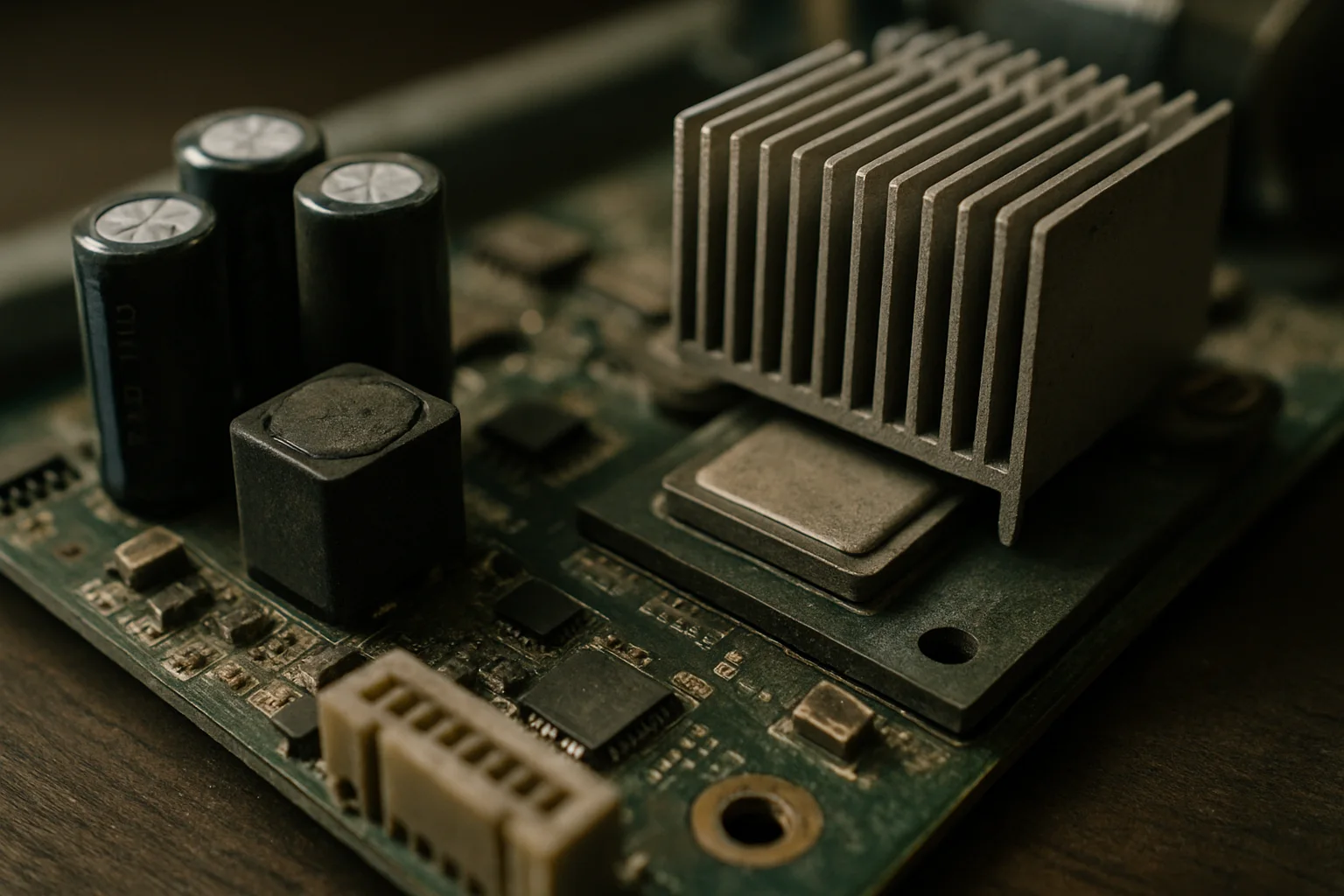
Antminer S23 Hydro Profitability: Real Numbers from a Live Hydro Mine
Most Antminer S23 Hydro profitability analyses start with a mining calculator screenshot and a generic $0.07/kWh assumption. We start somewhere different: a live 4-5 MW Bitcoin mining facility in Villarrica, Paraguay, running on surplus hydropower from the Itaipú dam at $0.028-0.057/kWh. That changes every number in the calculation. This article walks through the S23 Hydro specs, the real cost structure, and why the energy contract matters far more than the hardware choice.
---
What Is the Antminer S23 Hydro?
The Bitmain Antminer S23 Hydro is Bitmain's 2026 flagship hydro-cooled ASIC. It belongs to the S23 series, which includes the S23, S23 XP, S23 Pro, and S23 Hyd variants.
The "Hyd" suffix signals liquid cooling, water or glycol circulates through a closed loop, pulling heat directly off the chip package instead of relying on air fans. This allows significantly higher hashrate density per rack unit compared to air-cooled models.
Key published specifications for the S23 Hyd 3U variant (Antminer S23 Hyd 3U, 1.16 PH/s class):
| Spec | Value |
|---|---|
| Hashrate | ~1,160 TH/s (1.16 PH/s) |
| Power draw | ~15,000-16,000 W |
| Efficiency | ~13 J/TH |
| Form factor | 3U rack |
| Cooling | Immersion-adjacent liquid loop |
At roughly 13 J/TH, the S23 Hyd represents the current efficiency frontier for production-grade ASICs. For context: the S19 series we operate at GM3 in Paraguay runs at approximately 21-25 J/TH. ASIC efficiency has improved by roughly a factor of five since the S9's 90 J/TH in 2017. (Source: key-claims-canonical.md, ASIC model reference; ebook-haerter-als-gold-keyfacts.md, Kapitel 4)
---
The Profitability Equation, What the Calculators Get Wrong
Every mining profitability calculator uses the same formula:
Profit = (Produced BTC × BTC price) − (Electricity + Hardware + Operations)
That is correct as far as it goes. The problem is the electricity variable.
A public mining calculator typically defaults to $0.05-0.10/kWh. That reflects grid-connected hosting in North America or Europe. It does not reflect what a direct industrial hydropower contract looks like. (Source: ebook-haerter-als-gold-keyfacts.md, Kapitel 3)
"Mining is not a technology business where the cleverest engineers win. It is a location business where the cheapest energy wins." (Ebook „Härter als Gold", Kapitel 1+3)
So before running the S23 Hydro numbers, we need to pin down the right energy cost.
---
Energy Cost Is the Only Variable That Matters at Scale
At GM3 Technologies AG in Villarrica, Paraguay, we operate on direct hydropower contracts sourced from Itaipú-Überschuss, surplus electricity from the second-largest hydroelectric dam in the world. Paraguay consumes only around 50% of its own share of Itaipú's output. The national utility ANDE actively promotes industrial energy buyers to absorb the surplus.
Our contracted energy cost: $0.028-0.057/kWh, with an effective rate of 5.7 cents/kWh at current utilisation. (Source: company-knowledge-base.md §3; key-claims-canonical.md §3)
Now run the math on a single S23 Hyd 3U unit drawing 15,500 W continuously:
| Energy rate | Annual kWh (15.5 kW × 8,760 h) | Annual electricity cost |
|---|---|---|
| $0.028/kWh (Itaipú low) | 135,780 kWh | $3,802 |
| $0.057/kWh (Itaipú high / GM3 effective) | 135,780 kWh | $7,739 |
| $0.075/kWh (typical hosted mining, mid tier) | 135,780 kWh | $10,184 |
| $0.10/kWh (DACH hosting, conservative) | 135,780 kWh | $13,578 |
"A 1.8-cent difference in electricity cost equals approximately one million USD in annual outcome difference on a 6 MW farm." (Ebook „Härter als Gold", Kapitel 3, described as the single most important number in the book)
At the machine level, a $0.028/kWh operator and a $0.10/kWh operator face a roughly $9,800 per-unit annual cost gap on a single S23 Hyd 3U. On a 100-machine deployment, that is approximately $980,000 per year, before touching the Bitcoin price.
---
Antminer S23 Hydro Profitability: Three Price Scenarios
We use three Bitcoin price scenarios as the ebook recommends, no point forecasts, no price targets. (Source: key-claims-canonical.md §10)
Assumptions: S23 Hyd 3U at 1,160 TH/s, 15,500 W, current network difficulty and block reward of 3.125 BTC per block. (Source: key-claims-canonical.md §1; ebook-haerter-als-gold-keyfacts.md, Kapitel 1)
Estimated daily BTC yield per machine varies with network difficulty. At current global hashrate these numbers are approximations, difficulty adjusts every two weeks, and the machine's actual share of block rewards depends on total network participation.
| BTC Price | $60,000 | $80,000 | $105,000 |
|---|---|---|---|
| At $0.057/kWh (GM3 level) | Marginal / near break-even | Profitable | Strong margin |
| At $0.075/kWh (hosted mid-tier) | Loss-making | Marginal | Profitable |
| At $0.10/kWh (DACH hosted) | Deep loss | Loss-making | Marginal |
The critical observation: at the $60,000 BTC scenario, the S23 Hyd 3U is only viable at industrial hydropower rates. At DACH hosted-mining electricity rates, it loses money at $60,000 per BTC even with best-in-class hardware efficiency. (Source: ebook-haerter-als-gold-keyfacts.md, Kapitel 4)
"A robust mining model must be viable even if the price does not rise after a halving." (Ebook „Härter als Gold", Kapitel 1)
---
Why We Run the S19j XP Hydro Instead of the S23 Hyd
This is where the analysis gets honest, and where our own practice diverges from what a hardware spec sheet would suggest.
At GM3 Technologies AG, our primary fleet is the Bitmain S19j XP Hydro, supplemented by S19 Pro units. We are not running the S23 Hyd. Here is the deliberate reasoning. (Source: key-claims-canonical.md §3, Hardware-Strategie)
The S23 XP currently costs approximately $8,000-$10,000 per unit. The S19j XP Hyd is available at roughly $1,200-$1,800 per unit on secondary markets.
At $0.028-0.057/kWh, the efficiency delta between 13 J/TH (S23 Hyd) and 21-25 J/TH (S19j XP Hyd) does not justify the capital outlay difference over a four-year halving cycle.
Put concretely:
- An S23 Hyd at 13 J/TH, 15,500 W, at $0.057/kWh costs $7,739/year in electricity.
- An S19j XP Hyd at ~22 J/TH, ~5,000 W per unit, at $0.057/kWh costs approximately $2,500/year in electricity per unit.
The S23 Hyd produces far more hashrate per machine. But you could deploy roughly five to seven S19j XP Hyd units for the purchase price of one S23 Hyd, generating comparable aggregate hashrate at a fraction of the CAPEX, with lower stranded-capital risk if Bitcoin price falls sharply.
"Efficiency beats hashrate. But capital efficiency beats hardware efficiency." (Adapted from ebook-haerter-als-gold-keyfacts.md, Kapitel 9)
The S23 Hydro makes sense for operators who: (a) are at high electricity cost and need every efficiency gain to stay above break-even, or (b) have constrained physical space and need maximum hashrate density per rack unit.
At our Paraguay energy rates, (a) does not apply. We have space. So (c) we stay with Generation N-1 and N-2 hardware and deploy the capital cost difference into fleet breadth and reinvestment reserves.
---
The Hosting Uptime Problem, A Number Most Providers Don't Publish
The S23 Hydro is a liquid-cooled unit. It requires industrial infrastructure: a closed-loop cooling circuit, appropriate water quality, controlled ambient temperature. This is not a unit you place in a standard air-cooled colocation rack.
That matters for the hosted mining context.
Many DACH retail hosting providers advertise rates in the $0.045-0.075/kWh range alongside claims of 99% uptime. These two figures together deserve scrutiny.
"An advertised electricity rate of $0.045/kWh in DACH or EU grids almost always implies a curtailment-based or off-peak contract, real uptime of 50% to 80%, not a continuous 99% production profile." (Source: competitors-dach-detailed.md, Bitkern section; key-claims-canonical.md §3)
At GM3 in Paraguay, we achieved ~96% real uptime in 2025 at $0.028-0.057/kWh because Itaipú is a baseload hydroelectric direct-connection, not a curtailment-based grid product. (Source: key-claims-canonical.md §3)
When comparing hosting providers on $/kWh, always normalise for uptime. A 60%-uptime $0.045/kWh contract delivers fewer productive kWh per machine per year than a 96%-uptime $0.057/kWh contract. The effective cost per productive kWh at 60% uptime and $0.045/kWh is closer to $0.075/kWh, which wipes out the headline cost advantage entirely.
---
H3: What DACH Hosting Providers Charge for S23 Hydro-Class Hardware
The major DACH retail mining hosts publish the following rates:
- Bitkern (Zug, Switzerland): $0.045-$0.075/kWh, 48-month contracts, 99% uptime claimed (Source: competitors-dach-detailed.md)
- Cryptohall24 (Germany): from 4.5 ct/kWh (~$0.049/kWh), energy mix undisclosed (Source: competitors-dach-detailed.md)
- Miningshop.ch (Switzerland): from 0.065 CHF/kWh, Swiss grid (Source: competitors-dach-detailed.md)
"Miningshop.ch's 0.065 CHF/kWh is roughly twice Green Mining's energy cost from Itaipú hydropower." (Source: competitors-dach-detailed.md)
None of these providers publicly disclose the energy mix powering their S23 Hydro-class hosting. Green Mining's energy source is 100% hydropower from the Itaipú dam, published, contracted, audited. (Source: key-claims-canonical.md §2)
"Cryptohall24's advertised 4.5 ct/kWh does not disclose its energy mix; Green Mining publishes 100% Itaipú hydropower with a contracted long-term supply." (Source: competitors-dach-detailed.md)
---
The Real Alternative: Own the Mine, Not the Machine
There is a structural distinction that every ASIC profitability discussion eventually reaches.
When you buy an Antminer S23 Hydro and place it with a hosting provider, you are a service-contract counterparty. You own one machine that depreciates approximately 50-90% in value over 18-36 months. You bear the hardware-obsolescence curve, the hosting-provider counterparty risk, and the electricity margin. (Source: hosted-mining-vs-us.md §3; ebook-haerter-als-gold-keyfacts.md, Kapitel 7)
"Hosted mining is like buying a car and leaving the keys with the dealer." (Ebook „Härter als Gold", Kapitel 7)
GM Data Centers AG (GMD) offers a structurally different participation model via GM3 Technologies AG, the operating subsidiary in Villarrica, Paraguay.
Key structural facts of the GM3 co-mining model:
- Fleet exposure, not single-machine. GM3 operates ~1,500 active ASICs. Your ticket buys equity in the fleet.
- 100% hydropower at $0.028-0.057/kWh. Direct industrial contracts, not grid-retail.
- Quarterly BTC distributions to your wallet. No custodial intermediary.
- No energy or hardware margin. GMD's revenue comes from management fees and distributions, not from marking up electricity to investors. (Source: company-knowledge-base.md §2)
- Swiss AG structure. GM3 Technologies AG is a Schweizer Aktiengesellschaft with FINMA framework, BaFin-vetted Wertpapier-Informationsblatt (WIB granted 27 May 2025), and AGM voting rights. (Source: key-claims-canonical.md §4)
- Verified 2025 results. GM3 produced 14.5 BTC in 2025, generating CHF 1,441,454 revenue (~USD 1.77M), USD 566k EBITDA, USD 286k EBIT, at 96% uptime and 5.7 cents/kWh. (Source: key-claims-canonical.md §3)
- +17.5% EBIT margin at holding level in 2025, profitable at site level since Q1 2025. (Source: key-claims-canonical.md §2)
- 300+ investors across GMD, GM3, and GM4. (Source: key-claims-canonical.md §2)
"You own the data center. The data center produces your Bitcoin." (GM Data Centers AG brand tagline)
---
Heat Reuse: The S23 Hydro's Hidden Revenue Stream
One aspect absent from every mining calculator we have seen: waste heat monetisation.
The Antminer S23 Hyd runs liquid coolant at 70-80°C outlet temperature. That is industrial-grade process heat. It can dry agricultural produce, heat greenhouses, or feed aquaculture systems.
At GM3 in Paraguay, we run operational fruit-drying chambers for mango, pineapple, and papaya using ASIC waste heat, the "Bitcoin Mango" programme. Phase 1 processes approximately 10 tonnes per month, with a scale target of 25-30 tonnes per month. (Source: company-knowledge-base.md §9)
The financial impact:
- 20% heat monetisation shifts the cash break-even from ~$54,000/BTC to ~$44,000/BTC.
- 30% heat monetisation shifts it further to ~$39,000/BTC. (Source: ebook-haerter-als-gold-keyfacts.md, Kapitel 11)
"In a bear market, that is existential." (Ebook „Härter als Gold", Kapitel 11)
"It is not an ESG argument. That is mathematics." (Ebook „Härter als Gold", Kapitel 11)
A standalone S23 Hydro hosted with a DACH provider generates zero heat revenue. The infrastructure business model captures it. That gap is not visible on a mining calculator.
---
Six Criteria for Evaluating Any ASIC Profitability Claim
The ebook identifies six criteria that separate durable mining operations from cycle-dependent ones. Apply these to any S23 Hydro deployment you evaluate. (Source: ebook-haerter-als-gold-keyfacts.md, Kapitel 10)
1. Energy as a strategic asset. Location and energy contract matter more than machine specs. 2. Site control. Can you audit, verify, and intervene? 3. Reinvestment logic. Is there a defined capital rotation plan as hardware ages? 4. Cycle resilience. Is the cash break-even defined in BTC terms from day one? 5. Capital discipline. High equity base, counter-cyclical action. 6. Transparent governance. Auditable reporting, clear decision pathways.
The S23 Hydro is a capable machine. But a machine without a structure behind it is just hardware depreciating in a rack. (Source: hosted-mining-vs-us.md §4)
---
Summary: Antminer S23 Hydro Profitability in Numbers
| Dimension | S23 Hyd at $0.10/kWh | S23 Hyd at $0.057/kWh (GM3 level) |
|---|---|---|
| Annual electricity cost per unit | ~$13,578 | ~$7,739 |
| Viable at $60k BTC? | No | Marginal |
| Viable at $80k BTC? | No | Yes |
| Viable at $105k BTC? | Marginal | Strong margin |
| Heat reuse opportunity? | Depends on provider | Operational at GM3 |
| Hardware risk bearer | You | Fleet (operator) |
| Legal vehicle | Service contract | Swiss AG equity |
"Structure beats speculation." (Ebook „Härter als Gold", closing chapter)
The Antminer S23 Hydro is Bitmain's best hardware for 2026. But hardware is only one variable. Energy cost, uptime normalisation, and legal structure determine whether profitability is real or theoretical.
At $0.057/kWh on 100% hydropower with 96% real uptime, the math works through a halving cycle. At DACH retail hosting rates, it does not, regardless of which ASIC you choose.
---
Frequently Asked Questions
Q: What are the Antminer S23 Hyd 3U specs? A: The Antminer S23 Hyd 3U is Bitmain's 2026 flagship liquid-cooled ASIC. It delivers approximately 1,160 TH/s (1.16 PH/s) at around 15,000-16,000 W, for an efficiency of approximately 13 J/TH. The "3U" refers to the rack unit form factor. It requires a closed-loop liquid cooling infrastructure, it is an industrial-grade unit not compatible with standard air-cooled colocation.
Q: Is the Antminer S23 Hydro profitable in 2026? A: Profitability depends almost entirely on electricity cost and network difficulty. At $0.057/kWh (industrial hydropower, e.g., Paraguay via Itaipú), the S23 Hyd is profitable at Bitcoin prices above approximately $70,000-$80,000 at current difficulty. At $0.10/kWh (typical DACH hosted mining), the machine requires Bitcoin above $100,000 to produce meaningful positive returns. Always normalise for real uptime, not the headline figure advertised by hosting providers.
Q: Why does Green Mining use the S19j XP Hydro instead of the S23 Hyd? A: At $0.028-0.057/kWh energy costs, the efficiency advantage of the S23 Hyd (~13 J/TH vs. ~21-25 J/TH for the S19j XP Hyd) does not justify the roughly 5-7x purchase price premium per unit. One S23 Hyd costs approximately $8,000-$10,000; one S19j XP Hyd is available at $1,200-$1,800. At low energy rates, Generation N-1 hardware bought at steep discounts delivers superior ROI over a four-year halving cycle. The efficiency gain matters most when energy costs are high enough to make it the binding constraint, which is not the case at Itaipú rates.
Q: What is the difference between antminer s23 profitability and antminer s23 hydro profitability? A: The air-cooled S23 variants (S23, S23 XP, S23 Pro) run at lower power draw but also lower hashrate density than the S23 Hyd. The S23 Hyd's liquid-cooling system allows it to push significantly more TH/s per unit, but requires specialised infrastructure. For large-scale industrial operations with liquid cooling already in place, the S23 Hyd typically offers better economics per rack unit. For smaller operations without cooling infrastructure, the air-cooled S23 series has a lower deployment cost.
Q: How does ASIC hosting in Switzerland compare to operating at the GM3 Paraguay site? A: Swiss ASIC hosting (e.g., Miningshop.ch) starts at 0.065 CHF/kWh, roughly twice the effective energy cost at GM3 Paraguay ($0.057/kWh). Swiss grid electricity is structurally more expensive than surplus hydropower from Itaipú. Beyond cost, Swiss hosting is a service contract; GM3 participation is equity in a Schweizer AG with BaFin-vetted regulatory documentation and quarterly BTC distributions directly to investor wallets.
Q: Can I invest in GM3's hydro-powered Bitcoin mining operation? A: Yes. GM3 Technologies AG has issued tokenised Wertrechte (equity-linked instruments) on Bitcoin via Taproot Assets, distributed by Bitalo AG. The offering is governed by a Wertpapier-Informationsblatt granted by BaFin on 27 May 2025 (updated 12 March 2026). The minimum acquisition is 4,000 Wertrechte at CHF 0.25 each. Contact GM Data Centers AG at Dammstrasse 16, 6300 Zug, Switzerland, or visit greenmining.io for current offering documentation.
---
Past performance is not an indicator of future results. Investments in Bitcoin mining infrastructure carry risks, including the possible total loss of invested capital. This post is for informational purposes only and does not constitute investment, tax, or legal advice. Consult a qualified financial advisor before making investment decisions.