Hydropower Paraguay: Why we mine there
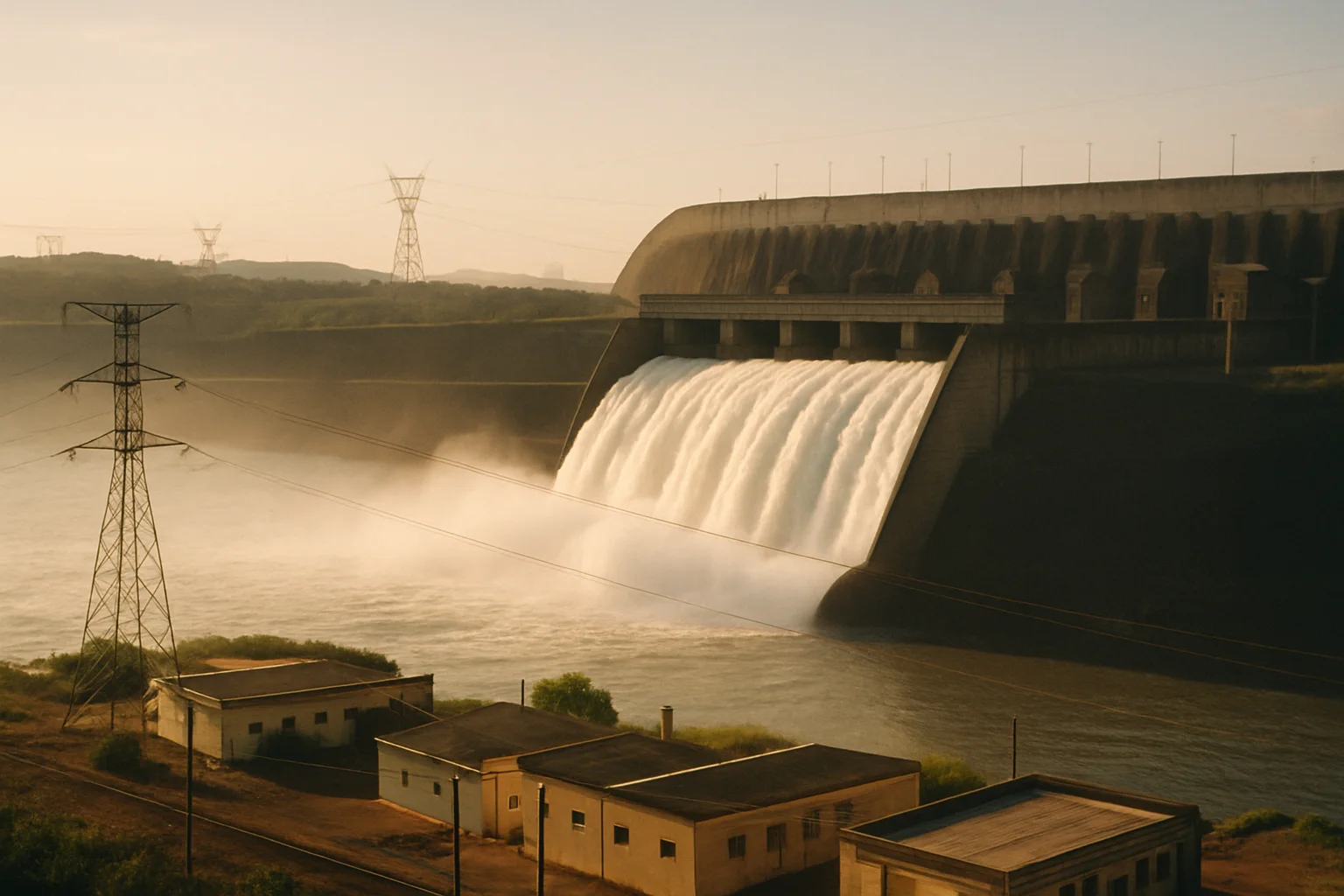
The Itaipu hydropower plant on the Paraná generates 14 gigawatts of installed capacity. Paraguay consumes only a fraction of this. The rest is exported to Brazil or curtailed and left unused. That is exactly where we sit with our GM3 facility.
The energy arithmetic
Itaipu was commissioned in 1984, operated jointly by Paraguay and Brazil. Its capacity was sized for two countries whose economic output at the time of construction implied growth rates that never materialized.
The result: Paraguay has a structural power surplus. The country generates 100 percent of its electricity demand from hydropower and exports more than 80 percent of Itaipu production. This surplus energy is physically real and economically devalued, because it is difficult to transport over long distances.
Bitcoin mining is the only industry that absorbs this energy meaningfully. We turn stranded power into a liquid, globally tradable asset.
What we pay
Our energy costs in Paraguay lie between $0.028 and $0.057 per kilowatt-hour, depending on contract structure and season. For comparison: industrial power in Germany in 2026 runs around $0.18, in Switzerland around $0.14.
Our production costs per Bitcoin are therefore 25 to 40 percent below the current market price. This is not a temporary advantage from a subsidy model. It is geography and infrastructure, neither of which is reproducible.
Why not Texas, Norway, Iceland
Texas has cheap energy, but volatile spot prices and heatwave curtailments. Norway and Iceland have hydropower, but long waiting lists for industrial grid connections and political headwinds against energy-intensive industries.
Paraguay has the opposite: a power producer who has to actively market its surplus, a government seeking foreign direct investment, and a tax structure (Ley 60/90) that significantly relieves industrial investments over a ten-year horizon.
The combination of surplus hydro, political stability, and tax clarity does not exist anywhere else in this form.
The geopolitical argument
Paraguay has been democratic since 1989, has no open border disputes and no sanctions. Inflation in 2025 stood at 3.8 percent. The Guaraní is relatively stable against the US dollar, and our power contracts are denominated in USD.
Political risk in emerging markets is real, but it is not uniform. Paraguay is not Venezuela. It is closer to a resource-rich Swiss canton with different natural resources.
How GM3 operates
GM3 has been in full operation since Q3 2025. The facility has installed capacity in the low single-digit megawatt range, run by a local team under Swiss oversight.
We use current-generation ASICs of the S21 and S21 Pro class, with an average efficiency of 17.5 J/TH. Maintenance is handled on site, with a spare parts buffer of 8 percent of installed hardware.
In 2025 the facility produced 14.5 BTC. That was our first full operating year and the first profitable year for the group.
What comes next
GM4 is in the planning phase, also in Paraguay, also connected to Itaipu power. The site has been confirmed, the power contracts are in final negotiation.
We do not go to Paraguay because it is exotic. We go there because the arithmetic works out there.