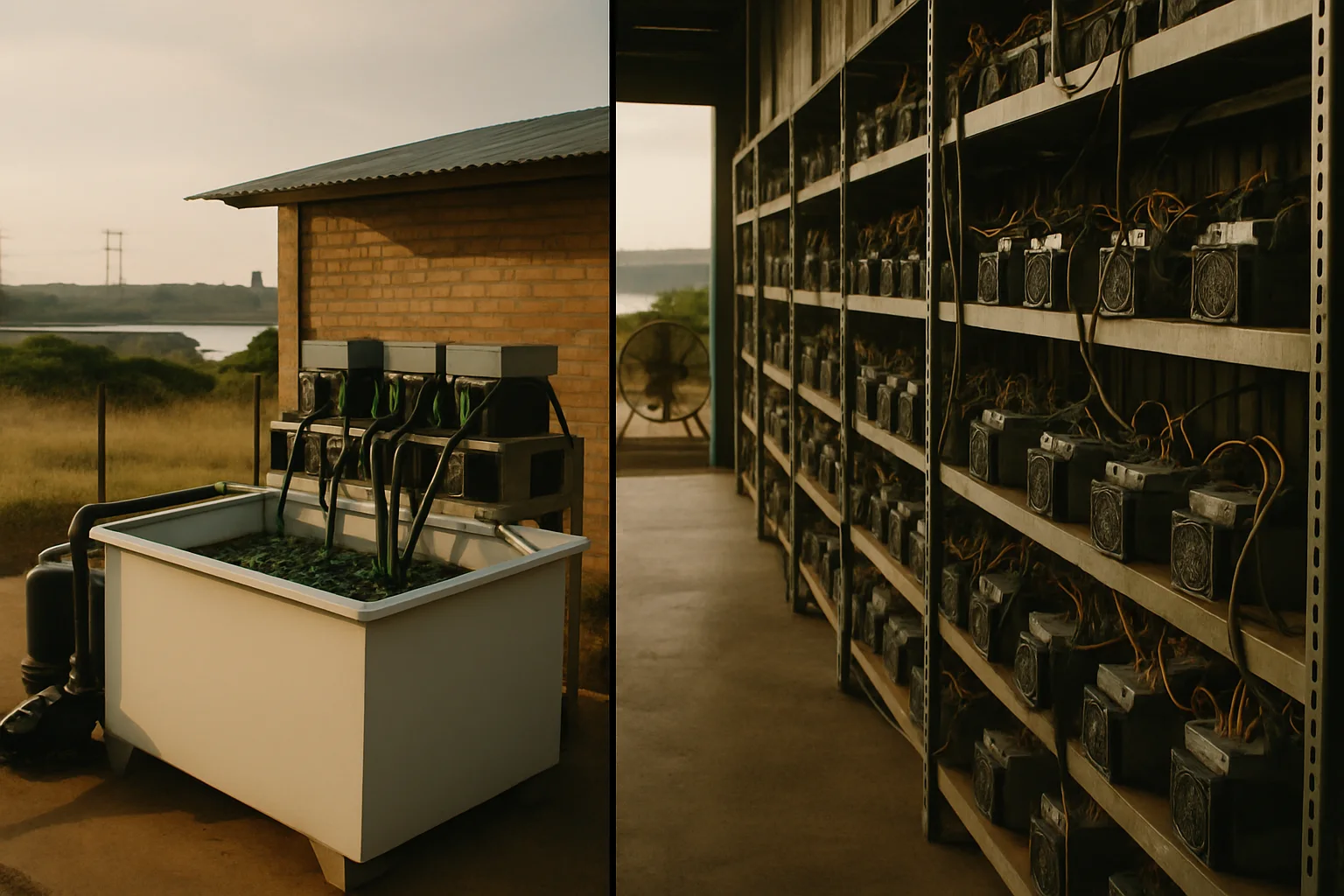
Hydro vs Air-Cooled Bitcoin Miners in Paraguay
Sascha Grumbach Founder & CEO, Zug, Switzerland
Jode Wardell Head of Operations, Villarrica, Paraguay
---
Green Mining operates hydro-cooled Bitcoin miners at its GM3 facility in Villarrica, Paraguay, achieving 99.45% average uptime and powering a commercial fruit-drying operation with recovered process heat. The facility runs on 100% hydropower at an electricity cost of $0.028-0.057/kWh, making it one of the most cost-efficient and thermally stable mining operations in South America.
---
Let's be clear about the problem we're actually solving in Paraguay.
It isn't hashrate. It's heat, humidity, dust, and operational discipline.
Achieving 99.45% average uptime here doesn't happen by chance. It is the outcome of designing around reality, not against it.
Paraguay is hot most of the year. Air systems technically function, but they live close to their limits. Hydro cooling is a decision to stop arguing with the climate and design around it instead.
---
Why We Run Hydro Miners in Paraguay
Uptime beats theory.
Air miners operate up to approximately 45°C intake temperature, but near that ceiling they throttle, trip, or underperform. That is not an edge case in Paraguay. It is normal operation. Every hour of throttling is BTC not mined.
> "In Paraguay's ambient conditions, air-cooled miners spend a material share of operating hours at or near their thermal ceiling, making hydro cooling a reliability requirement, not a premium option."
Hydro decouples chip temperature from ambient air. Heat goes into water, chips stay stable, uptime stays predictable.
Heat becomes part of the business model, not a nuisance.
With hydro, heat is already captured in a controlled water loop. That makes heat reuse practical, not aspirational.
> "Green Mining's GM3 facility in Paraguay routes recovered process heat directly into a commercial fruit-drying facility, converting otherwise rejected energy into a second revenue stream from the same power input."
The drying operation sits downstream of the mining loop and turns otherwise rejected energy into a second revenue stream. Same electrons, same megawatts, more output.
Air-cooled systems can theoretically reuse heat, but the working medium is low-grade hot air in large, poorly controllable volumes. Hydro delivers stable temperatures, predictable flow rates, and a fluid stream that industrial process engineers can work with.
Density and noise matter at scale.
Hydro allows higher compute density per container and dramatically lower acoustic output. Fans are consumables and a constant failure point in Paraguay's dusty, humid conditions. Hydro shifts mechanical wear into pumps and plate heat exchangers, which are easier to monitor and maintain systematically.
> "Replacing fan arrays with closed-loop water circuits reduces the most common single-point failure mode in hot-climate Bitcoin mining facilities."
---
What Hydro Actually Costs
More capex and more responsibility.
Hydro means miners plus pumps, piping, plate heat exchangers, filtration, water treatment, controls, and spares inventory. This only works if you are willing to run it like an industrial system, not a shed full of fans.
> "Hydro-cooled mining infrastructure carries higher upfront capital expenditure than air-cooled equivalents, and the performance advantage is only realised with disciplined engineering and maintenance protocols."
Failures are less frequent but higher impact if you are careless.
Air failures are typically single-machine events. Hydro failures can cascade across a loop if redundancy and monitoring are poorly designed. That is precisely why engineering discipline and maintenance protocols matter more than hardware brand selection.
Water is now a first-class operational risk.
Leaks, water chemistry, fouling, and corrosion are all manageable. None are ignorable. GM3 treats water management as a primary operational discipline, on the same level as hash rate monitoring.
Less plug-and-play mobility.
Air miners are modular and straightforward to redeploy. Hydro sites are integrated systems. If your strategy depends on rapid relocation, hydro is the wrong tool.
---
Where Air-Cooled Still Makes Sense in 2026
Air miners have improved significantly. Top-tier units are efficient and commercially viable across many operating environments.
Air cooling remains the right choice when:
- Speed of deployment matters more than thermal optimisation
- The site calls for minimal infrastructure and simpler staffing
- The facility lifecycle is short or uncertain
- There is no plan to reuse process heat
In Paraguay, however, air cooling pays a persistent tax in uptime, maintenance frequency, and acoustic noise, because ambient conditions rarely provide a thermal buffer.
> "Paraguay's climate eliminates the margin that makes air cooling viable at scale. Sites that operate for years in this environment are overwhelmingly moving toward liquid cooling."
---
The Energy Context: Why Paraguay's Grid Matters
GM3 runs on 100% hydropower sourced from Paraguay's national grid, which is supplied predominantly by the Itaipu Dam, one of the largest hydroelectric facilities in the world. This gives the facility a structurally low carbon intensity and a stable, low-cost electricity tariff of $0.028-0.057/kWh.
> "At $0.028-0.057/kWh from 100% hydropower, GM3's energy cost structure places it in the lowest-cost decile of global Bitcoin mining operations."
According to the IEA's Hydropower Special Market Report, hydropower remains the world's largest source of renewable electricity and offers the most consistent capacity factors of any renewable generation technology. For mining operations requiring 24/7 baseload power, hydro grids are structurally better matched than intermittent sources.
On-chain data from Glassnode confirms that post-halving mining economics increasingly favour operators with sub-$0.04/kWh energy costs, as the April 2024 halving reduced the block subsidy to 3.125 BTC per block. Facilities paying above that threshold face sustained margin compression as difficulty adjusts upward.
---
The Real 2025 Takeaway
Air miners got more efficient. That did not change the climate.
In hot, humid environments, the operation is won on uptime and controllability, not datasheet J/TH figures.
Hydro enables GM3 to:
- Stabilise mining performance across ambient temperature swings
- Control precisely where process heat is directed
- Feed recovered heat directly into a commercial fruit-drying facility
- Extract more revenue value from the same power input and capital base
> "GM3 Technologies AG has been operationally profitable since Q1 2025, with the hydro-cooling and heat-reuse system functioning as designed from the first quarter of commercial operation."
The decision is not ideological or purely about sustainability credentials. It is practical engineering for a specific climate and a specific business model.
We choose plumbing, pumps, and process control instead of losing performance to hot air and fan arrays. That decision drives mining operations at GM3 and makes the model succeed in Paraguay. It is focused, scalable, and built to outperform.
---
About Green Mining
Green Mining enables investors to become co-owners of sustainable Bitcoin mining facilities. Green Mining develops, owns, and operates tokenized Bitcoin mining data centers, with a commercial heat-reuse model that generates an additional revenue stream by drying fruits from otherwise wasted thermal energy. Profits are distributed as quarterly dividends in Bitcoin directly to shareholders' wallets.
Green Mining's subsidiary mining model is designed to maximise dividends for investors, including the company itself, which holds a 20% stake in each subsidiary after the fundraising process. Investors receive common Class-A shares identical to those held by the founders. Minimum investment starts at CHF 250,000.
Green Mine #003 (GM3), operated by GM3 Technologies AG, is Green Mining's third sustainable mining project, currently being developed in Villarrica, Paraguay. GM3 has been operational since the end of 2024, already generating profits since Q1 2025, and is currently being expanded with additional capital.
Media Assets: Green Mining Press Kit
Media Contact: Valentine Pleser
---
Frequently Asked Questions
Why does Green Mining use hydro cooling instead of air cooling in Paraguay? Paraguay's ambient temperatures regularly approach or exceed the safe intake ceiling for air-cooled miners, causing throttling and unplanned downtime. Hydro cooling decouples chip temperature from ambient air, which is why GM3 achieves 99.45% average uptime. The recovered process heat is also routed into a commercial fruit-drying facility, creating a second revenue stream from the same power input.
What is the electricity cost at the GM3 facility in Paraguay? GM3 operates on 100% hydropower at an electricity tariff of $0.028-0.057/kWh. This positions the facility in the lowest-cost segment of global Bitcoin mining operations and provides a durable margin buffer as network difficulty increases post-halving.
How does the fruit-drying operation generate revenue? The heat extracted from the mining loop, which would otherwise be rejected to the environment, is redirected at a controlled temperature into the fruit-drying facility. The drying operation processes agricultural produce and generates commercial revenue independently of Bitcoin price movements, diversifying the cash-flow profile of the investment.
What is the minimum investment in Green Mining? The minimum investment ticket is CHF 250,000. Investors receive common Class-A shares identical to those held by the founders, and profits are distributed as quarterly dividends in Bitcoin directly to shareholders' wallets, subject to economic success and corresponding shareholder resolution.
How does Green Mining handle the April 2024 Bitcoin halving impact on profitability? The April 2024 halving reduced the block subsidy to 3.125 BTC per block. GM3's structural advantage, electricity at $0.028-0.057/kWh from 100% hydropower, combined with the secondary heat-reuse revenue stream, is specifically designed to preserve operating margins in a post-halving environment where higher-cost operators face sustained compression.
---
Past performance is not an indicator of future results.